
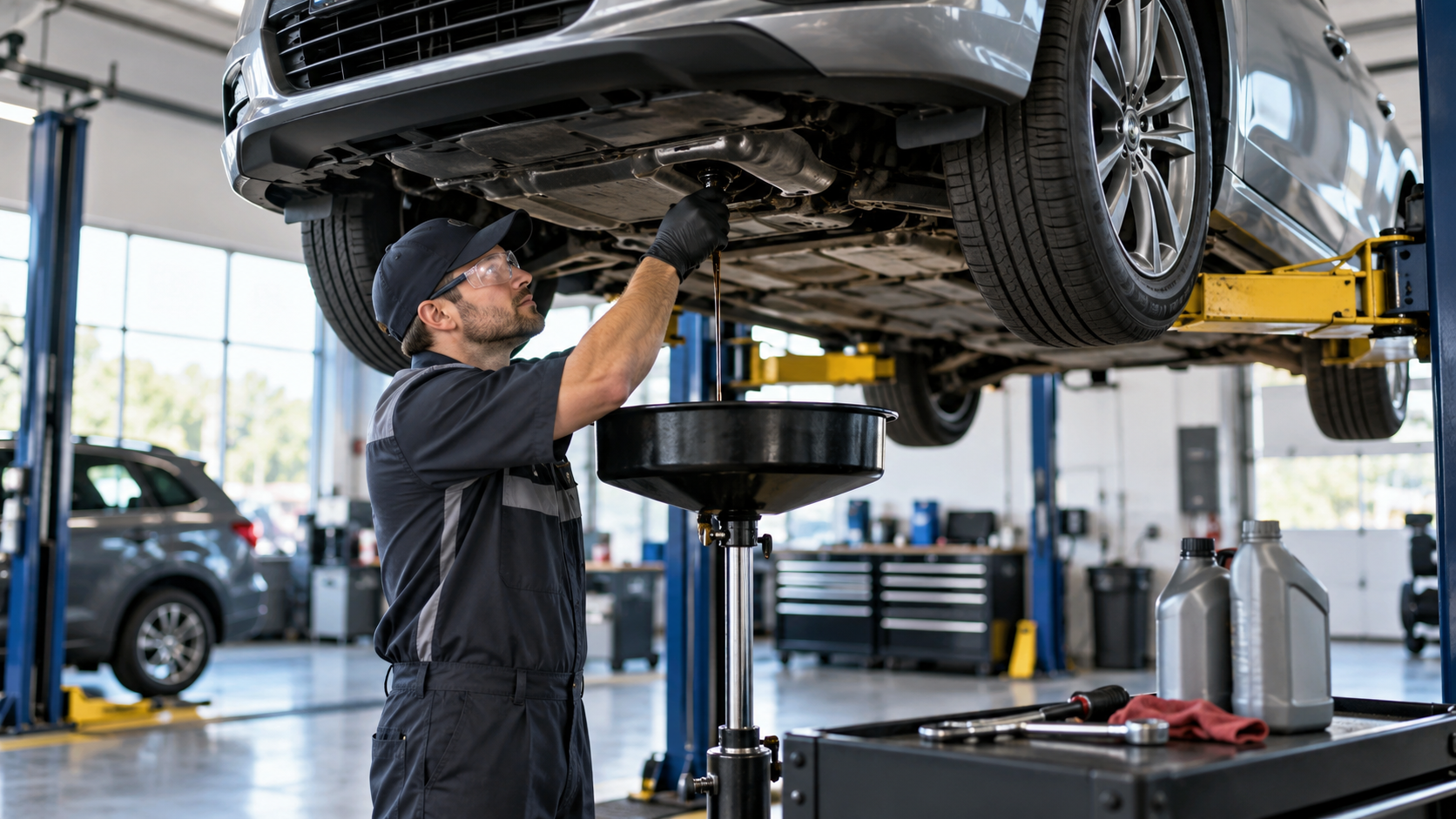
You need an oil change. Simple enough, right?
Then you start looking around and suddenly there are ten different options. The dealership wants you to book an appointment. A quick-lube shop says you can stay in the car and be gone in 15 minutes. The neighborhood mechanic has great reviews but no openings until Thursday. A mobile technician will even come to your driveway.
So where is the best place to get an oil change?
There is no single answer that works for every car or every driver. The right place depends on what you care about most: price, speed, manufacturer-specific knowledge, convenience, inspection quality, or having one mechanic who knows your vehicle.
For a newer car still under warranty, a dealership may make sense. For a ten-year-old commuter car, a trusted independent shop can be hard to beat. If you’re squeezed for time, a quick-lube shop may be the easiest option. And if your car needs more than oil, going somewhere that can properly diagnose other problems is usually smarter than picking the fastest bay in town.
The trick is not finding the most famous logo. It is finding a shop that uses the correct oil, installs the proper filter, follows the right service procedure, and does not turn a $70 maintenance visit into a pile of random add-ons.
First, Know What an Oil Change Actually Includes
An oil change sounds basic because, mechanically, it is.
The old engine oil is drained or extracted, the oil filter is replaced, and fresh oil meeting the engine manufacturer’s requirements is added.
But those few steps still leave room for mistakes.
The wrong oil viscosity can be installed. The engine can be overfilled or underfilled. A filter may be wrong for the application. A drain plug can be overtightened. An old filter gasket can stick to the engine and cause a leak. A splash shield can be left loose.
That is why price alone should not decide where you go.
A slightly cheaper oil change is not much of a bargain if you leave with an oil leak.
The Main Places You Can Get an Oil Change
Most U.S. drivers end up using one of a few common service types.
| Service Type | Main Advantage | Possible Drawback | Good Fit For |
|---|---|---|---|
| Dealership | Brand-specific experience and service records | Often costs more and may require an appointment | Newer vehicles and manufacturer-specific maintenance |
| Independent repair shop | Personal service and broader repair capability | Quality varies from shop to shop | Drivers who want one long-term mechanic |
| Quick-lube chain | Fast service with little waiting | Experience can vary by location | Routine oil changes when convenience matters |
| Tire and service center | Can combine oil service with tires, brakes, and inspections | May require more waiting than a quick-lube shop | Drivers handling several maintenance items at once |
| Mobile mechanic | Service at home or work | Not every location or vehicle is supported | Busy drivers who value convenience |
| DIY | Full control over oil and filter choice | Requires tools, space, cleanup, and proper disposal | Owners comfortable doing basic maintenance |
Is the Dealership the Best Place to Get an Oil Change?
Sometimes, yes.
A dealership can be especially convenient when your car is relatively new. Technicians regularly work on the same brand, service information is readily available, and maintenance can be recorded in the manufacturer’s system.
Dealerships also know about current service campaigns, recalls, software updates, and model-specific maintenance requirements.
That matters more on some modern vehicles than people realize.
An oil change appointment may also include a multi-point inspection. If your vehicle has an unusual filter arrangement, electronic oil-level system, underbody panels, or a specific reset procedure, dealership technicians are likely familiar with it.
But dealership service is not automatically superior.
Some dealership oil changes cost more than independent options, and appointment times can be less convenient. You may also encounter recommendations for additional maintenance while the vehicle is there.
Those recommendations are not necessarily bad, but ask what is required by the maintenance schedule and what is simply suggested based on inspection.
What About Independent Repair Shops?
A good independent repair shop can be one of the most practical places to handle routine oil changes.
The biggest advantage is continuity.
If the same shop sees your car several times a year, technicians gradually learn its history. They may remember that your valve cover started sweating oil last year, that your front brakes were getting low, or that one tire has been wearing unevenly.
That kind of context can be useful.
Independent shops also tend to handle far more than oil changes, so if they discover a coolant leak, worn belt, damaged suspension part, or other problem, they can often inspect it properly rather than simply telling you to visit another business.
The downside is that independent shops are independent.
One can be excellent. Another can be sloppy. Reviews, certifications, cleanliness, communication, and reputation matter more than the word “independent.”
Quick-Lube Shops: Fast, Easy, and Often Pretty Convenient
For many drivers, quick-lube shops are the default answer.
Companies such as Jiffy Lube, Valvoline Instant Oil Change, Take 5, and other regional operators built their businesses around making routine maintenance fast.
You may not need an appointment. Some locations allow you to stay inside the vehicle. Service can often be finished while you would still be sitting in a dealership waiting room.
If your car needs only straightforward routine maintenance and the location has a strong reputation, this can be perfectly reasonable.
But here is the important part: judge the individual location, not only the company name.
A national chain can have an excellent shop in one city and a mediocre location somewhere else. Staffing, management, technician experience, and attention to detail differ.
Look at recent local reviews rather than assuming every branch operates exactly the same way.
Are Quick-Lube Shops Safe for Modern Cars?
Generally, they can service many modern vehicles without trouble, but not every car is equally straightforward.
Some European vehicles require specific oil approvals rather than simply a viscosity such as 5W-30. Certain cars use cartridge filters, unusual oil capacities, complicated underbody shields, or electronic measurement instead of a traditional dipstick.
If you drive something with very specific lubrication requirements, ask what exact oil the shop plans to install.
Do not settle for “full synthetic” as the whole answer.
The bottle needs to meet the specifications required by the vehicle manufacturer.
Tire Shops and General Service Centers Can Be a Good Middle Ground
Many tire shops also perform oil changes, brake work, alignments, batteries, suspension service, and routine maintenance.
This can be handy if you want several things checked in one visit.
For example, maybe you need an oil change and a tire rotation. A general service center can often handle both without sending you to two different businesses.
These shops may also have better inspection and repair capability than a small express-oil facility.
The tradeoff is speed. You might not be in and out quite as quickly.
What About Walmart, Costco, and Other Retail Service Centers?
Large retailers and warehouse-style businesses can sometimes offer competitive maintenance pricing, though services vary by location.
Walmart Auto Care Centers, for example, provide oil-change services at many locations. Some other retailers focus more heavily on tires and related services.
The appeal is pretty obvious: drop off the vehicle, do your shopping, and come back when it is finished.
But again, local execution matters.
Check what services the specific location offers, what oil is included, which filter is installed, and whether appointments are available.
Mobile Oil Changes Are Becoming More Practical
For someone working from home or juggling kids, errands, and meetings, driving to a shop and waiting for an oil change can feel surprisingly annoying.
Mobile mechanics solve that problem.
A technician comes to your driveway, parking area, or workplace and performs the service there.
The convenience is hard to beat.
Pricing varies, and apartment garages or workplaces may have restrictions on automotive maintenance. The technician also needs safe access to the vehicle.
But for a straightforward oil change, mobile service can be a solid option.
What Makes an Oil Change Shop Actually Good?
Forget the waiting-room coffee for a minute.
The important stuff is pretty boring, which is exactly how you want an oil change to be.
- The shop confirms the correct oil viscosity and specification for your engine.
- It uses a quality oil filter that fits the application correctly.
- Technicians verify the final oil level.
- The drain plug and filter are tightened correctly rather than attacked with an impact tool.
- The shop checks for leaks before returning the car.
- Service records clearly show which oil and filter were installed.
- Technicians reset the maintenance reminder when appropriate.
- Staff can explain recommendations without pressuring you.
If a shop cannot tell you what oil it plans to put in your car, that is not a great sign.
Full Synthetic, Synthetic Blend, or Conventional?
The vehicle’s requirements come first.
Many modern engines are designed around full synthetic oil or manufacturer-approved oils with specific performance standards.
Older engines may allow conventional or synthetic-blend oil, but even then, synthetic oil can offer advantages in temperature stability and resistance to breakdown.
Do not simply buy whichever option is cheapest on the menu.
Check the owner’s manual or manufacturer maintenance information.
If the engine requires a particular approval, the oil should meet it.
How Much Should an Oil Change Cost?
There is no useful single nationwide number.
Prices vary by city, oil type, engine size, filter cost, vehicle design, and how many quarts the engine holds.
A small four-cylinder engine requiring five quarts of common synthetic oil is usually cheaper to service than a large truck engine that takes eight or nine quarts.
European models with manufacturer-specific oil approvals can also cost more.
Instead of focusing only on the advertised starting price, ask what the final price includes.
| Cost Factor | Why It Changes the Price |
|---|---|
| Oil quantity | Large engines may need significantly more oil |
| Oil specification | Some engines require specialized approved oils |
| Filter type | Premium or cartridge filters may cost more |
| Vehicle design | Skid plates and underbody panels can add labor |
| Location | Labor and operating costs vary across the U.S. |
| Extra services | Tire rotation, inspection, fluid checks, and other work may be added |
Watch Out for the “Starting at” Price
You see a sign advertising a very cheap oil change and think, perfect.
Then the final bill is almost twice as much.
That can happen because the advertised amount covers only a certain number of quarts, a basic filter, or a particular grade of oil.
Your car may require more oil or a different specification.
Ask for the expected total before service begins.
That one question prevents a lot of frustration.
Do You Need an Oil Change Every 3,000 Miles?
For most modern cars, the old 3,000-mile rule is outdated.
Many vehicles now have longer manufacturer-recommended intervals, especially when synthetic oil is used.
The actual interval depends on the vehicle, engine, oil specification, driving conditions, and maintenance schedule.
Some cars also have an oil-life monitoring system that estimates when service is due.
Follow the vehicle manufacturer’s guidance instead of automatically changing perfectly good oil because of an old rule.
But Severe Driving Can Shorten the Interval
This catches people because “severe service” does not necessarily mean racing through the desert.
Repeated short trips can qualify because the engine may not stay hot long enough to evaporate moisture and fuel contamination from the oil.
Frequent idling, towing, dusty driving, extreme temperatures, and heavy stop-and-go use can also change maintenance needs.
If most of your driving is short urban trips, check the severe-service schedule in your owner’s manual.
Should You Get a Tire Rotation With the Oil Change?
Often, yes, if the timing lines up with your tire-rotation interval.
Combining services saves a second trip and helps tires wear more evenly.
This is one reason general repair shops, dealerships, and tire service centers can be convenient compared with a pure quick-lube facility.
But do not rotate tires simply because someone offers it.
Some vehicles have directional tires, staggered wheel sizes, or other configurations that limit normal rotation patterns.
What About the Free Multi-Point Inspection?
A quick inspection can be genuinely helpful.
Technicians may catch a leaking coolant hose, worn wiper blade, low tire pressure, brake wear, damaged belt, or fluid leak before you notice it.
But a free inspection is also an opportunity for a business to sell additional services.
That is not automatically shady. Shops need to tell customers when they find problems.
The smart move is separating urgent repairs from maintenance that can wait.
Ask for measurements or evidence.
If a shop says your brake pads are worn, ask how many millimeters remain. If the air filter is dirty, ask to see it. If a fluid service is recommended, ask whether the manufacturer maintenance schedule calls for it.
Common Upsells You May Hear About
Oil changes often come with a menu of additional services.
Some may be legitimate. Others may not be needed yet.
- Engine air filter replacement
- Cabin air filter replacement
- Fuel-system cleaning
- Transmission fluid service
- Coolant service
- Brake fluid service
- Wiper replacement
- Battery testing or replacement
- Tire rotation
- Differential or transfer-case fluid service
Do not reject every recommendation automatically.
Just compare it with the vehicle’s maintenance schedule and actual condition.
Does Getting an Oil Change Somewhere Else Void Your Warranty?
For U.S. vehicle owners, you generally are not required to have routine maintenance performed at the dealership simply to keep a vehicle warranty intact.
You are still responsible for following required maintenance and keeping appropriate records.
That means documentation matters.
Keep receipts showing the date, mileage, oil type, and service performed.
If you change the oil yourself, keep receipts for the oil and filter and note when the work was completed.
How to Judge Online Reviews Without Getting Fooled
A five-star average does not tell the whole story.
Read recent reviews, especially those from people who describe the actual service they received.
Look for repeated comments about leaks, damaged drain plugs, long waits, pressure to buy unnecessary work, or billing problems.
Also notice whether management responds professionally when something goes wrong.
Every busy shop eventually gets an unhappy customer. What matters is whether the same complaint appears over and over.
Is the Closest Place Usually Good Enough?
For a basic oil change, maybe.
You do not necessarily need to cross town searching for some mythical perfect garage.
If a nearby shop has strong recent reviews, clearly explains what oil it uses, follows manufacturer specifications, and stands behind its work, convenience has real value.
A good shop five minutes from home can be more useful than an amazing one an hour away.
When the Dealership Makes More Sense
There are situations where paying dealership prices can be reasonable.
A brand-new vehicle may have complimentary maintenance included. Certain vehicles require specialized procedures. Your car may have an open recall or service campaign that can be handled during the same appointment.
You may also prefer keeping all service history inside the dealer network.
If those things matter to you, the extra cost can make sense.
When an Independent Shop Makes More Sense
If you own the car long-term, developing a relationship with a competent independent mechanic can be extremely useful.
Instead of visiting one business for oil, another for brakes, another for suspension work, and another when the check-engine light appears, you have one shop that already knows the vehicle.
This becomes more valuable as the car ages.
A fifteen-year-old vehicle often needs judgment and diagnosis more than brand-specific dealership amenities.
When Quick-Lube Service Makes the Most Sense
Maybe you have a two-year-old commuter car, no warning lights, no leaks, and you simply need routine oil service during your lunch break.
That is exactly where quick-lube businesses shine.
Pick a well-reviewed location, confirm the correct oil before they start, and keep the receipt.
You do not need to turn every oil change into a half-day event.
Can You Bring Your Own Oil and Filter?
Some independent shops allow this, while many chains and dealerships do not.
Bringing your own supplies can make sense if your vehicle needs a specific specialty oil or if you prefer a particular filter.
But ask the shop before arriving.
Also understand that warranty responsibility can become less clear when the customer supplies the parts.
If a filter you provided fails, the shop may not accept responsibility for the component itself.
What Should You Check After an Oil Change?
You do not have to crawl underneath the vehicle with a flashlight.
A few quick checks are enough.
- Look at the final invoice and confirm the correct oil grade was listed.
- Check that the maintenance reminder was reset if your car uses one.
- After parking, look under the car for fresh oil spots.
- Check the oil level according to the manufacturer’s procedure if your vehicle has a dipstick.
- Listen for unusual engine noise after service.
- Make sure no oil-pressure warning remains illuminated after startup.
- Keep the receipt with your maintenance records.
A faint smell from a small amount of spilled oil may occasionally appear after service, but persistent smoke or active leaking needs attention.
What If the Oil Light Comes On After an Oil Change?
Do not ignore an oil-pressure warning.
If the red oil-pressure warning appears while the engine is running, shut the engine off as soon as it is safe to do so.
Check the oil level according to the vehicle instructions and contact the shop.
The warning can indicate low oil pressure, which is different from simply being due for maintenance.
Driving with inadequate oil pressure can damage an engine quickly.
What If You See Oil Leaking After Service?
A few drops of residue left on a splash shield can occasionally fall after an oil change.
An active leak is different.
If fresh oil keeps appearing on the ground, the level is falling, or oil is visibly running from the engine area, return to the shop or arrange inspection.
Possible causes include a loose drain plug, damaged washer, filter sealing problem, or another leak unrelated to the oil change.
Do Expensive Cars Need Expensive Oil Changes?
Not because the badge is expensive.
But some premium and performance vehicles require larger quantities of oil, specialized filters, unusual access procedures, or oils carrying specific manufacturer approvals.
Those requirements can make the service legitimately more expensive.
The key question is not “Is this a luxury car?”
It is “What does this engine actually require?”
Should You Choose a Shop Based on Oil Brand?
Usually not by brand alone.
Major oil brands sell products covering many different specifications and quality levels.
What matters is whether the exact product meets the viscosity and performance specifications required for your engine.
A familiar logo on the bottle does not automatically make every oil from that company correct for every vehicle.
How to Pick the Best Place Without Overthinking It
If you want the simplest decision process, start with your priorities.
Need service today and nothing else is wrong? A well-reviewed quick-lube location is reasonable.
Want someone to inspect the whole vehicle and maintain it for years? Find a reputable independent repair shop.
Drive a newer vehicle with complimentary maintenance or special service requirements? The dealership makes sense.
Need an oil change while you’re working from home? Check whether a reputable mobile service operates in your area.
There is no trophy for driving twenty miles farther just to change engine oil.
FAQ
What is the best place to get an oil change?
For many drivers, a reputable independent repair shop offers a good mix of quality, inspection capability, and long-term service. Dealerships can make sense for newer cars, while quick-lube shops are useful when speed and convenience matter most.
Are quick-lube places okay for oil changes?
Yes, a well-run quick-lube shop can handle routine oil changes perfectly well. Check recent reviews and confirm that the shop will install oil meeting your vehicle manufacturer’s requirements.
Is it better to get an oil change at the dealership?
Not necessarily. Dealerships offer brand-specific experience and can be convenient for newer vehicles, but independent shops and reputable quick-lube locations can also perform routine oil changes correctly.
Where is the cheapest place to get an oil change?
Prices vary by location, vehicle, oil quantity, and oil specification. Retail service centers and promotional quick-lube offers can be inexpensive, but compare the final price rather than the advertised starting price.
Do I have to go to the dealer for oil changes while my car is under warranty?
Routine maintenance generally does not have to be performed at the dealership in the U.S. Keep documentation showing that the required maintenance was completed with the correct products and at the appropriate intervals.
Is full synthetic oil worth paying more for?
If your manufacturer requires full synthetic oil, use it. Even when synthetic is optional, it can provide strong resistance to heat and breakdown. Follow the oil specification listed for your engine rather than choosing only by price.
How can I tell whether an oil change shop is trustworthy?
Look for strong recent local reviews, clear pricing, clean documentation, technicians who can explain the required oil specification, and recommendations based on measurements or manufacturer maintenance schedules rather than pressure.
Conclusion
So where is the best place to get an oil change?
For most drivers, the answer is not one national chain or one type of shop.
It is the place that does the basic job correctly, uses the right products, charges a fair price, and treats your vehicle carefully.
If you drive a newer car and want manufacturer-specific service, the dealership can be a solid choice.
If you want one mechanic to handle maintenance and repairs over many years, a reputable independent shop may suit you better.
If your calendar is packed and the car simply needs routine oil service, a good quick-lube location can save a lot of time.
And if leaving home is the biggest inconvenience, mobile maintenance is worth considering.
The shop’s name matters less than its work.
Ask what oil will be installed. Confirm that it meets the correct viscosity and manufacturer specification. Check what filter is being used. Ask for the final price before service begins.
Those few questions tell you far more than a giant roadside sign advertising a cheap oil change.
Also think beyond today’s visit.
If you have an older vehicle, there is real value in finding a mechanic who sees the car regularly and understands its history.
A good shop may notice trends that a different express service location every six months will not.
On the other hand, if your car is new, dependable, and still needs little beyond scheduled maintenance, you may not need that level of relationship yet.
Convenience is a legitimate factor.
Just do not confuse convenience with carelessness.
A fast oil change should still include the correct oil, correct fill level, proper filter installation, and a basic leak check.
And a more expensive oil change should not automatically be assumed to be better.
Dealership marble floors do not make engine oil more effective. Neither does a fancy waiting room.
What protects your engine is the correct oil, changed at an appropriate interval, installed correctly.
That is the whole game.
If you are comparing two places and one is slightly cheaper while the other has a long history of strong local reviews and clear service records, paying a few extra dollars may be worthwhile.
But you also do not have to turn routine maintenance into a luxury purchase.
Check the vehicle’s maintenance schedule, understand what your engine requires, and pick a shop that can clearly meet those requirements.
Keep every receipt.
Watch for leaks afterward.
Check the oil level occasionally.
And if a shop starts recommending several additional services, ask why.
A trustworthy technician should be able to explain whether something is required by mileage, based on measured wear, or simply worth keeping an eye on.
That distinction matters.
In practical terms, the best place to get an oil change is usually a reputable, convenient shop that knows your vehicle, uses the correct oil and filter, gives you clear documentation, and does not make routine maintenance harder than it needs to be.
Find that place, and stick with it.
Leave a Reply