
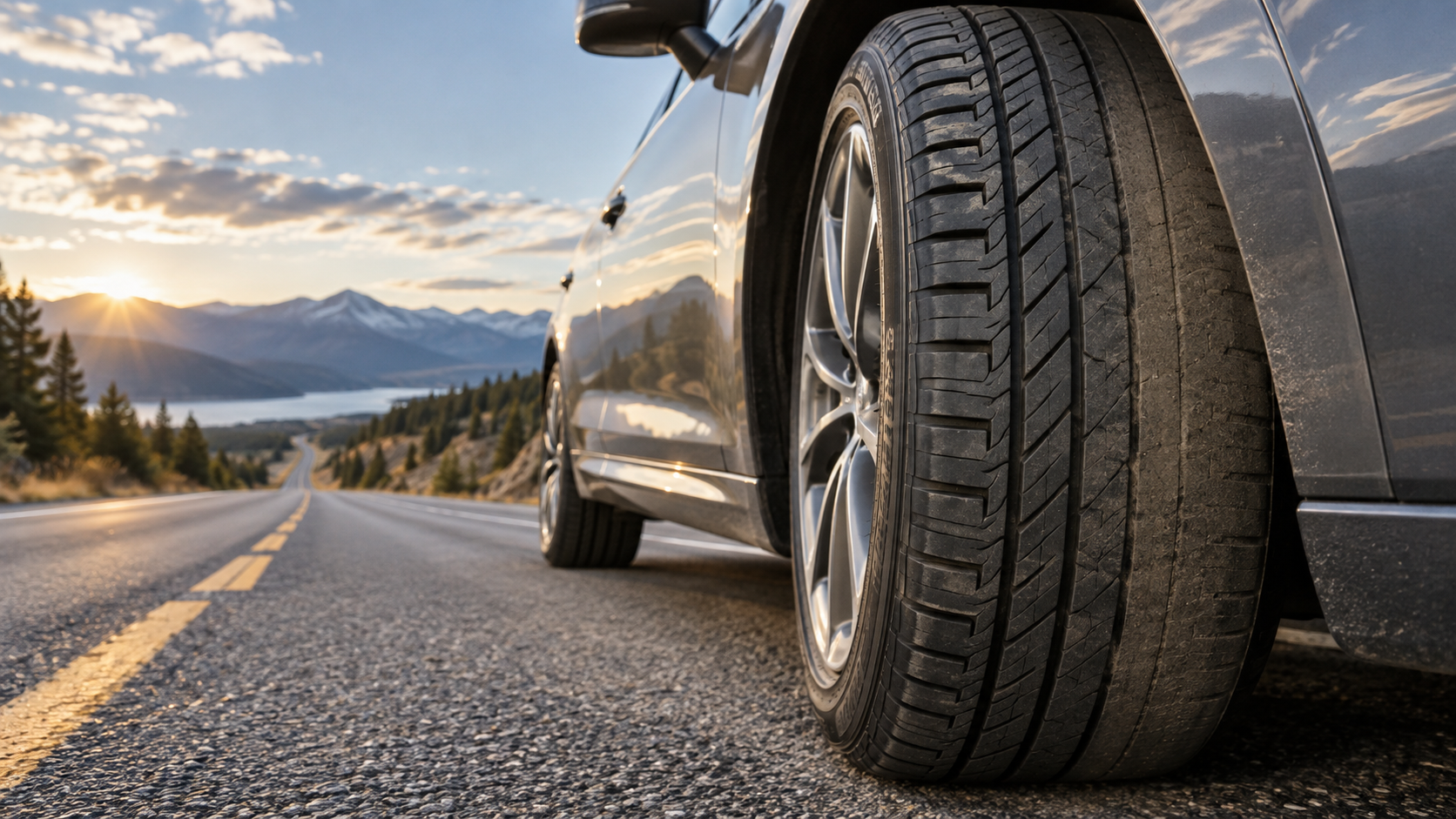
You buy a fresh set of tires, hand over a not-so-small amount of money, and naturally wonder: how long are these things actually going to last?
For many passenger cars in the U.S., a reasonable real-world range is roughly 40,000 to 70,000 miles. Some touring tires can last longer. Performance tires may wear out much sooner. And occasionally a tire reaches the end of its useful life because of age, cracking, or damage before the tread is technically worn out.
So if you’re asking how many miles do tires last, there isn’t one magic number.
The answer depends on tire type, rubber compound, driving habits, alignment, inflation pressure, climate, road conditions, vehicle weight, and even where the tires spend most of their lives.
A set driven gently on smooth highways in Ohio can have a very different life from the same model driven every day through hot Arizona pavement, mountain roads, potholes, and aggressive city traffic.
Mileage matters. But it isn’t the only clock running.
Typical Tire Life by Tire Type
Different tires are built for different jobs.
A long-wearing touring tire is designed with durability and everyday comfort in mind. A sticky summer performance tire trades some tread life for stronger grip and sharper handling. An all-terrain truck tire deals with another set of compromises entirely.
That is why comparing tire mileage without considering the type of tire can be misleading.
| Tire Type | Common Real-World Mileage Range | Why Life Varies |
|---|---|---|
| Standard all-season | About 40,000-70,000 miles | Driving style, rotation, alignment, road conditions |
| Touring / grand touring | About 50,000-80,000+ miles | Often built for longer tread life and highway use |
| Performance all-season | About 30,000-60,000 miles | Softer compounds and spirited driving can increase wear |
| Summer performance | About 20,000-40,000 miles | High-grip rubber tends to wear faster |
| All-terrain | About 40,000-60,000+ miles | Vehicle weight, towing, off-road use, rotation patterns |
| Winter tires | Often several winter seasons rather than one fixed mileage | Soft cold-weather compounds and seasonal use |
These are broad ranges, not guarantees.
A tire with an advertised 70,000-mile treadwear warranty does not automatically deliver exactly 70,000 miles in every situation. Warranty terms normally come with requirements involving maintenance, rotation, proper inflation, and qualifying tread wear.
And a tire can become unsuitable before reaching the warranty mileage because of damage or age.
Why Some Tires Last 70,000 Miles and Others Barely Make 30,000
Rubber is always a compromise.
Harder tread compounds can often wear more slowly. Softer compounds may offer stronger grip but disappear faster.
Then the car itself enters the picture.
A light front-wheel-drive sedan usually treats tires differently from a heavy electric SUV with lots of instant torque. A sports car with aggressive suspension settings can wear the inside edges quickly. A pickup that regularly tows heavy loads puts additional stress on its tires.
And drivers make a huge difference.
Two people can own identical cars, fit identical tires on the same day, and end up replacing them tens of thousands of miles apart.
Driving Style Has a Bigger Effect Than Many People Think
Tires wear whenever they transfer force between the road and the vehicle.
Accelerate hard and the tire has to transfer more force. Brake aggressively and the same thing happens in reverse. Corner quickly and the tread blocks scrub against the pavement.
None of that is automatically bad. Cars are meant to accelerate, brake, and turn.
But repeated aggressive driving speeds up wear.
Driving habits that commonly shorten tire life include:
- Hard launches and frequent full-throttle acceleration.
- Late, heavy braking.
- Fast cornering.
- Hitting potholes or curbs at speed.
- Carrying heavy loads regularly.
- Towing near the vehicle’s limits.
- Skipping tire rotations.
- Driving for long periods with incorrect tire pressure.
A calm commute is simply easier on rubber than repeated stoplight launches and hard cornering.
Tire Pressure Can Quietly Destroy a Good Set of Tires
This one is easy to miss because the tires may still look normal from a few feet away.
Underinflation changes how the tread sits on the road. It can increase heat buildup, raise rolling resistance, and cause excessive wear toward the shoulders.
Overinflation can create its own problems and may contribute to unusual wear patterns.
The correct pressure is normally listed on the vehicle’s tire-information label, commonly found on the driver’s door jamb. It may also appear in the owner’s manual.
Do not automatically inflate tires to the maximum pressure printed on the tire sidewall.
That sidewall number is not the everyday pressure recommendation for your specific vehicle.
Check tire pressure when the tires are cold, meaning they have not been driven enough to heat substantially. Tire pressure naturally changes with temperature, so fall and winter are common times for drivers to suddenly see a low-pressure warning.
Does Highway Driving Make Tires Last Longer?
Often, yes.
Steady highway driving usually means fewer hard starts, fewer sharp turns, and less braking than stop-and-go city traffic.
Think of a tire during a long highway trip. Once the car reaches speed, the tire mostly rolls at a steady rate.
Now think of an urban commute: accelerate, brake, turn, park, pull away, hit a pothole, repeat.
The city cycle tends to create more frequent changes in load and direction.
Of course, highway mileage can still be tough on tires if the vehicle is overloaded, tire pressure is wrong, alignment is off, or the driver regularly travels at high speeds in extreme heat.
Alignment Can Turn 60,000-Mile Tires Into 25,000-Mile Tires
A badly aligned vehicle can ruin tires surprisingly fast.
If the wheels are not pointing in the correct direction relative to the vehicle and each other, the tires may scrub across the pavement instead of rolling cleanly.
You may notice:
- One edge of the tire wearing much faster than the other.
- Feathered tread that feels rough in one direction.
- The steering wheel sitting off-center.
- The car pulling to one side.
- Uneven wear between the front and rear tires.
- A new set of tires beginning to look worn far too early.
Sometimes alignment changes gradually as suspension parts wear. It can also shift after a hard pothole impact or curb strike.
If one tire is wearing dramatically differently from the others, don’t simply replace the tire and move on.
Figure out why it happened.
Why Tire Rotation Matters
Your four tires do not necessarily work equally hard.
On a front-wheel-drive vehicle, the front tires handle steering, much of the braking, and engine power. They often wear more quickly than the rear tires.
Rear-wheel-drive and all-wheel-drive vehicles have their own wear patterns.
Rotating tires periodically moves them between positions so wear is distributed more evenly.
The correct interval and rotation pattern depend on the vehicle and tires, so follow the schedule in the owner’s manual or tire manufacturer’s maintenance guidance.
Many drivers rotate tires around regular service intervals, often somewhere in the neighborhood of 5,000 to 8,000 miles, but the correct schedule for your car takes priority.
Some tire setups cannot be rotated normally. Staggered vehicles may use wider rear tires than front tires. Directional tires also have restrictions on where they can be moved.
Tread Depth Matters More Than the Odometer
Imagine two cars.
Car A has tires with 35,000 miles and plenty of even tread remaining.
Car B has tires with only 22,000 miles, but one front tire has worn almost smooth along the inside edge because of an alignment problem.
Which set is closer to replacement?
Clearly, Car B.
Mileage tells you how far the tire has traveled. Tread depth tells you how much usable rubber is actually left.
In the U.S., 2/32 inch is a commonly used minimum tread-depth threshold and is the legal minimum in many states. But performance in rain and snow can deteriorate well before a tire becomes completely bald.
That matters because tread grooves need enough depth to move water away from the contact patch.
The closer a tire gets to its wear bars, the less margin it generally has in heavy rain.
How to Check Tire Tread
The easiest method is to look at the built-in treadwear indicators.
These small raised bars sit inside the main tread grooves. As the tread wears down, the surface gets closer to those bars.
A tread-depth gauge is even better. They’re inexpensive and give you an actual measurement.
When checking the tire, measure more than one spot.
Look near both shoulders and in the center. Uneven tread can tell you just as much as the lowest measurement.
A tire with plenty of tread on the outside but almost none on the inside is still a worn tire.
Mileage Is Only Half the Story: Tires Also Age
Here is the part that surprises people who do not drive very much.
Tires can age even while sitting still.
Rubber changes over time through exposure to oxygen, heat, sunlight, and environmental conditions. The tire may become harder, develop cracking, or lose some of the properties it had when new.
So a ten-year-old tire with only 18,000 miles is not automatically “almost new.”
Automakers and tire manufacturers publish age-related replacement guidance, and recommendations vary. Many call for closer inspection as tires get older, with replacement limits often falling somewhere around six to ten years depending on the manufacturer and application.
Check the recommendations for your actual vehicle and tire brand rather than assuming tread depth is the only factor.
How Do You Know How Old a Tire Is?
Look for the DOT tire identification marking on the sidewall.
The final four digits of the date code indicate the week and year of manufacture.
For example, a code ending in 2424 means the tire was manufactured during the 24th week of 2024.
The full code may appear on only one side of the tire, so you might need to look at the inner sidewall.
The date tells you when the tire was manufactured, not when it was installed.
Heat Can Shorten Tire Life
Heat is hard on rubber.
That is especially relevant in warmer parts of the U.S. where pavement temperatures can get brutal for months at a time.
Arizona, Nevada, Texas, Florida, and Southern California can expose tires to very different conditions from a mild northern climate.
High ambient temperatures, sustained highway driving, underinflation, and heavy loads can all increase operating temperature.
This does not mean tires in hot states automatically fail early, but climate is one reason tire age and condition matter alongside mileage.
Cold Weather Has Its Own Effect
Cold temperatures reduce tire pressure because the air inside contracts as temperature falls.
That is why tire-pressure warning lights seem to appear all over America on the first properly cold morning of fall.
If drivers ignore the warning and continue running underinflated tires, wear can increase.
Winter conditions also change what “enough tread” means.
A tire that technically has tread remaining may still perform poorly in snow once its grooves become shallow.
For drivers in places such as Minnesota, Colorado, Michigan, Vermont, or upstate New York, winter capability may become the deciding factor before the tire reaches its absolute minimum tread depth.
How Long Do All-Season Tires Last?
All-season tires are common on U.S. passenger vehicles because they balance tread life, comfort, cost, and year-round flexibility.
Many fall somewhere around 40,000 to 70,000 miles in normal driving.
Long-wear touring models can exceed that under favorable conditions.
But the “all-season” label covers a huge range.
A comfort-focused touring tire with a long treadwear warranty has different priorities from an ultra-high-performance all-season tire fitted to a sporty sedan.
Do not judge them by the category name alone.
How Long Do Performance Tires Last?
Performance tires are where drivers sometimes get a nasty surprise.
The car handles beautifully, but the tread seems to disappear faster than expected.
That’s partly the nature of the design.
Performance rubber often prioritizes grip, steering response, braking, and heat management over maximum mileage.
Depending on the tire and vehicle, 20,000 to 40,000 miles may not be unusual for summer performance tires.
Driving style makes an enormous difference here.
A powerful rear-wheel-drive car driven enthusiastically can consume rear tires remarkably quickly.
How Long Do Tires Last on an EV?
Electric vehicles do not automatically destroy tires, but several EV characteristics can contribute to faster wear.
Many EVs are relatively heavy because of their battery packs. Electric motors can also deliver strong torque immediately.
Combine vehicle weight, instant acceleration, and enthusiastic driving and the tires can work pretty hard.
On the other hand, an EV driven smoothly with proper alignment and pressure can still get good tire life.
Some tires are designed specifically with EV weight, efficiency, noise, and wear characteristics in mind.
How Long Do Truck and SUV Tires Last?
Again, it depends on what the truck actually does.
A crossover carrying groceries and kids to school has a very different life from a pickup hauling equipment or towing a large trailer.
Heavy loads increase stress on tires.
All-terrain tires also have large tread blocks designed to deal with dirt, gravel, and other rough surfaces. Their wear characteristics differ from highway-focused truck tires.
If most of your miles happen on pavement, a highway-terrain tire may generally provide different longevity and road behavior from an aggressive all-terrain or mud-terrain design.
What Makes Tires Wear Out Early?
When a tire dies early, there is usually a reason.
Sometimes it’s obvious, like a sidewall damaged by a pothole. Other times the cause builds slowly for thousands of miles.
| Wear Pattern or Problem | Possible Cause | What to Check |
|---|---|---|
| Both outer shoulders wearing | Possible chronic underinflation | Cold tire pressure and possible leaks |
| Center wearing faster | Possible pressure or setup issue | Vehicle-recommended pressure |
| One edge worn heavily | Alignment or suspension issue | Wheel alignment and suspension condition |
| Front tires wearing much faster | Normal drivetrain pattern or lack of rotation | Rotation schedule |
| Uneven patches or cupping | Suspension, balance, alignment, or tire issue | Shocks, struts, wheel balance, alignment |
| Rapid wear across entire tread | Driving style, tire compound, load, road conditions | Usage and tire type |
Does Tire Brand Determine How Long Tires Last?
Brand matters less than the actual tire model and its intended purpose.
Major manufacturers sell everything from long-wearing economy or touring tires to high-performance tires designed primarily for grip.
So saying one brand “lasts longer” without comparing equivalent tire types does not tell you much.
Look at the tire category, treadwear warranty, load rating, speed rating, vehicle fitment, and intended driving conditions.
Then consider owner experience as supporting information, not as a guarantee.
What About Treadwear Ratings?
You may notice a UTQG treadwear number molded into the sidewall of many passenger tires sold in the U.S.
A higher number generally indicates a tire designed to wear more slowly in the standardized comparison system.
But it is not a direct mileage prediction.
A tire marked 600 does not mean it will last 60,000 miles, and comparing numbers across brands is not as straightforward as many shoppers assume.
Think of the rating as one piece of information, not an odometer forecast.
How Can You Make Tires Last Longer?
You do not need to baby the car or inspect the tires every morning.
A few boring habits make the biggest difference:
- Check cold tire pressure regularly.
- Use the pressure specified for the vehicle.
- Rotate tires according to the recommended schedule when the setup allows it.
- Have alignment checked when wear becomes uneven or the car’s behavior changes.
- Avoid repeated hard launches and aggressive cornering if maximum tread life matters to you.
- Inspect tires after major pothole or curb impacts.
- Do not regularly overload the vehicle.
- Look at tread wear across the entire width of each tire.
- Replace damaged tires rather than trying to squeeze out a few more thousand miles.
None of those ideas are exciting.
But they’re cheaper than replacing four tires early.
Should You Replace All Four Tires at Once?
Not always.
On many two-wheel-drive vehicles, replacing tires in pairs can be acceptable when the remaining tires are still in good condition.
But tire manufacturers and vehicle manufacturers may have specific recommendations about placement and matching.
All-wheel-drive vehicles deserve extra attention.
Some AWD systems require tires to have closely matched rolling circumference. A large difference in tread depth between new and worn tires may create problems for the drivetrain on certain vehicles.
Check the owner’s manual before replacing only one tire on an AWD vehicle.
What if One Tire Wears Out Much Faster?
That is a clue.
Do not simply install another tire and forget about it.
If one tire is significantly more worn than the others, inspect pressure history, alignment, suspension parts, brake drag, wheel balance, and rotation history.
The old tire may be showing you a mechanical problem.
Put a new tire into the same situation and it may suffer the same fate.
Can a Tire Have Good Tread and Still Need Replacement?
Absolutely.
Tread depth is only one part of tire condition.
A tire may need replacement because of:
Sidewall bulges, deep cuts, exposed cords, structural damage, repeated air loss, severe cracking, internal damage from being driven while flat, or age.
A tire with a bulge should be taken seriously. A bulge can indicate internal structural damage.
Likewise, not every puncture can be safely repaired. Location and damage matter.
Why You Should Look at Your Tires, Not Just the Mileage
The odometer cannot see a sidewall bubble.
It doesn’t know your alignment has shifted.
It cannot tell you that one rear tire has a nail slowly leaking air.
And it certainly doesn’t know whether the tread on the inner shoulder is almost gone while the outer tread still looks healthy.
A quick visual inspection once in a while is more useful than obsessing over an exact mileage number.
Turn the steering wheel if necessary so you can see more of the front-tire tread. Look at the rear tires from several angles.
If something looks dramatically different between tires, investigate it.
FAQ
How many miles do tires usually last?
Many passenger-car tires last roughly 40,000 to 70,000 miles, although some touring tires can exceed that and performance tires may wear out much earlier. Driving habits, tire type, alignment, inflation, climate, and vehicle weight all affect actual mileage.
Can tires last 80,000 miles?
Some long-wearing touring tires can reach around 80,000 miles or more under favorable conditions. That does not mean every tire will. Tread depth, condition, age, maintenance, and manufacturer guidance still determine when replacement is appropriate.
Is 40,000 miles good for a set of tires?
It can be. Forty thousand miles is normal for many tire types, especially performance-oriented models. For a long-wear touring tire, however, 40,000 miles may be relatively early if the tread is already worn out.
How often should I check my tire tread?
Check it periodically and whenever you check tire pressure, prepare for a long trip, notice unusual handling, or see uneven wear. A tread-depth gauge makes the check quick and inexpensive.
Should I replace tires based on age even if they have tread?
Age matters because rubber changes over time. Tire and vehicle manufacturers publish their own age-related inspection and replacement guidance, often becoming more conservative as tires approach roughly six to ten years old. Follow the recommendations for your specific tire and vehicle.
Why did my tires wear out before the mileage warranty?
Improper inflation, alignment problems, missed rotations, aggressive driving, suspension issues, heavy loads, road conditions, and tire type can all shorten tread life. Warranty coverage also depends on the manufacturer’s terms and required maintenance.
How can I tell when my tires need replacement?
Check tread depth and wear bars, but also inspect for cracking, bulges, cuts, exposed cords, uneven wear, repeated air loss, and age. If you’re unsure about damage, have the tire inspected professionally.
Conclusion
So, how many miles do tires last?
For a typical U.S. passenger vehicle, somewhere around 40,000 to 70,000 miles is a useful starting point.
But it is only a starting point.
A long-wearing touring tire driven gently on the highway may travel considerably farther. A sticky performance tire on a powerful car may be finished around 25,000 or 30,000 miles and have done exactly what it was designed to do.
The important thing is not to treat mileage like an expiration timer.
Your tires do not know what number is printed on the odometer.
They know heat, pressure, load, road surface, alignment, acceleration, braking, cornering, and time.
That is why two sets of identical tires can have completely different lives.
If you want more miles from your tires, start with the boring stuff. Keep them properly inflated. Rotate them on schedule when the setup allows it. Fix alignment problems before one edge of the tread disappears. Do not ignore suspension issues. And take a look at the tires every now and then.
Also remember that plenty of tread does not automatically mean a tire is healthy.
Age, cracking, structural damage, sidewall bulges, and punctures can make replacement necessary before the tread reaches its minimum depth.
The opposite is also true.
You should not replace a healthy three-year-old tire simply because somebody online claimed every tire “only lasts 40,000 miles.” If the tread is healthy, wear is even, the tire is undamaged, and it remains within the applicable age guidance, mileage alone does not condemn it.
Pay special attention when wear looks uneven.
If one tire is bald on the inside while the others look decent, you probably have more than a tire problem. Alignment or suspension may be involved.
If both front tires disappear much faster than the rear pair, rotation history may be part of the story.
If all four tires wear surprisingly fast on a heavy, powerful vehicle, the combination of tire compound, vehicle weight, and driving style may explain it.
There is no single number that covers every driver in the United States.
Someone commuting gently on interstate highways in a compact sedan has a different tire life from someone towing a trailer through Texas heat or enjoying a performance car on twisty roads every weekend.
And that is fine.
Tires are designed with different priorities.
Some chase mileage. Some chase grip. Some are built for snow, dirt, comfort, low noise, heavy loads, or sharp steering.
The trick is knowing what you bought and checking how it is actually wearing.
If you’re trying to estimate when your current tires will need replacement, don’t rely on mileage alone. Check their present tread depth, age, wear pattern, pressure history, and condition.
Those details tell you far more.
A tire might last 30,000 miles.
Another might go past 70,000.
The right time to replace it is when its condition, tread, age, or damage says it is finished – not simply when the odometer reaches a neat round number.
Leave a Reply