
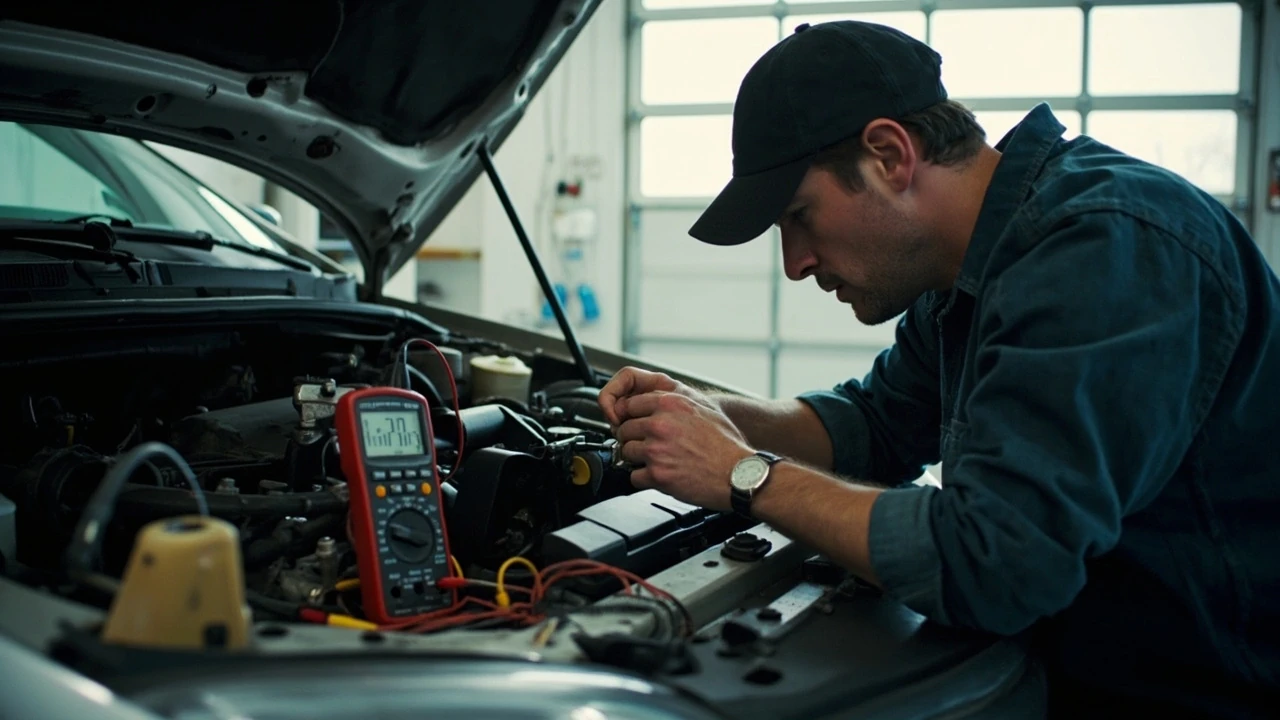
How to start a car with a bad starter
A starter that no longer engages can leave you stranded even when the battery is fully charged and the engine has fuel. The important first step is to identify what the engine is actually doing: nothing at all, a slow crank, or a normal crank followed by no start. That distinction separates an electrical starting problem from a fuel, ignition, or immobilizer issue and prevents you from replacing parts that were never at fault.
You may be able to start the car temporarily by jump-starting a weak battery, cleaning a corroded battery terminal, or using the correct starter-bypass procedure on a compatible vehicle. Those methods treat the condition causing the symptom; they rarely repair a failed starter motor, solenoid, or starter relay. If the starter makes no sound, an unsafe bump-start attempt will not solve the problem.
This guide explains how to diagnose a bad starter, which temporary methods are reasonable, and when the vehicle should be towed rather than repeatedly cranked. It also covers automatic and manual-transmission limits, battery checks, safety precautions, and the repair choices that depend on whether the failure is in the starter assembly or its control circuit.
Confirm that the starter is the actual problem
A starter does not create spark, fuel, or compression. It only turns the engine fast enough for the engine to start on its own. If the engine cranks normally but does not run, the starter has already completed its part of the job, and troubleshooting should move to fuel delivery, ignition, compression, air intake, or the anti-theft system.
Listen carefully during the first few seconds you turn the key. The sound pattern is more useful than the amount of time you spend cranking.
- No sound at all: The starter may not be receiving power, or the solenoid may be failing to connect the battery to the starter motor. A blown fusible link, corroded terminal, damaged wiring, failed relay, or defective ignition switch can create the same symptom.
- Slow, heavy cranking: The battery may be weak, the battery connections may be dirty, or the starter may be drawing too much current. Listen for a strained grinding sound that continues with each revolution.
- Fast cranking with no start: The starter is probably working. A healthy starter typically spins the engine rapidly, but the engine still refuses to run.
- Starter spins without moving the engine: The starter may be turning in the air, or the flexplate or flywheel may no longer engage the starter drive.
- A brief spin followed by silence: This can indicate a failing solenoid or relay, especially if the behavior changes between attempts.
Do not assume a dead battery is the cause simply because the starter is quiet. The opposite is also possible: a heavily discharged battery can click without supplying enough current to run the starter motor. Testing the battery and the voltage reaching the starter separates these possibilities.
| What you hear or see | Likely system | What to check next |
|---|---|---|
| Nothing happens when you turn the key | Starter control circuit, fuse, relay, battery connection, ignition switch, or solenoid | Confirm battery state and battery voltage at the starter terminal during a start request |
| Repeated clicking without engine movement | Weak or discharged battery, poor terminal connection, or solenoid not engaging | Inspect terminals and perform a controlled load or voltage test |
| Slow grinding or dragging | Weak battery, worn starter motor, or damaged starter drive | Measure voltage during cranking and test the starter separately if voltage is adequate |
| Engine cranks quickly but does not run | Fuel, spark, compression, intake, or immobilizer system | Do not replace the starter; diagnose the no-start condition after cranking |
| Starter spins rapidly but engine does not turn | Damaged starter drive, flexplate, or flywheel | Stop cranking and have the starter-to-engine engagement inspected |
Another person can often hear a difference that is easy to miss from the driver’s seat. If the situation allows, ask someone to listen while you operate the starter. Record the exact behavior rather than describing it only as “the car won’t start.”
Check the battery, terminals, and safety before trying again
Before attempting repeated starts, make sure the battery and its connections are not the simpler cause. Open the hood, locate the battery, and inspect the terminal clamps. Corrosion, loose hardware, a broken terminal, or a battery cover that is not seated can interrupt the high-current path needed by the starter.
You will need basic safety gear and a few tools:
- Safety glasses and gloves
- A socket wrench or wrench appropriate for the battery terminal clamp
- Clean water, a rag, and a stiff brush for ordinary surface corrosion
- A multimeter or battery tester for checking voltage
- Properly rated jumper cables if you intend to jump-start the vehicle
- The vehicle owner’s manual for battery location, terminal markings, and any specified jump-start procedure
Keep metal tools away from both battery terminals at the same time, and avoid creating sparks around the battery. Modern vehicles may have sensitive electronics, so disconnecting a battery or attempting improvised jumper connections without understanding the system can create additional problems. If the battery casing is swollen, leaking, hot, or visibly damaged, do not jump-start it or place your face close to it. Move away from the area and arrange professional assistance.
Basic voltage readings help establish whether the battery has enough stored energy:
| Test point and condition | Typical result | Meaning |
|---|---|---|
| Across battery terminals with engine off | Approximately 12.6 volts on a healthy, rested 12-volt battery | Supports a fully charged state, though surface charge and battery age can affect interpretation |
| Across battery terminals while cranking | Should remain well above 9.6 volts | A collapse toward or below 9.6 volts suggests the battery may be unable to support starting |
| Between positive battery terminal and starter casing during cranking | Should be close to battery voltage | Little voltage may point to poor wiring, a bad ground, or resistance in the main starter cable |
| Between positive battery terminal and starter solenoid trigger during cranking | Approach battery voltage in a normal system | No trigger voltage points toward a control-circuit, relay, switch, or wiring problem |
These figures are diagnostic guides rather than a substitute for the service information for your vehicle. Some start-stop systems, hybrids, and electrically managed vehicles require specialized procedures. For battery testing details and the numbers that affect interpretation, see what car battery voltage should be.
Use temporary starting methods only when the diagnosis supports them
A temporary method is appropriate when it addresses the failed part of the system. Jump-starting a discharged battery, for example, may restore enough current to operate the starter. It will not normally repair a starter that cannot engage or a damaged main starter cable.
Jump-starting the car
Use a vehicle with a compatible 12-volt electrical system. Many gasoline-powered cars from recent decades use a 12-volt system, but the owner’s manual remains the proper source. Do not assume every passenger car, work truck, or hybrid uses the same procedure.
- Position both vehicles safely, switch off both engines, and apply the parking brake. Keep the vehicles apart from traffic and follow the manual’s guidance on cable connection order.
- Identify the positive and negative terminals on each battery. The positive terminal is commonly marked with a plus sign; the negative may be marked with a minus sign or connected to a nearby ground point.
- Connect one jumper cable’s positive clamp to the disabled car’s positive battery terminal.
- Connect the other end of that cable to the working vehicle’s positive battery terminal.
- Connect the second cable’s negative clamp to a suitable ground point on the disabled vehicle, if the manufacturer specifies that method, and then to the working vehicle’s negative terminal.
- Start the working vehicle and allow it to run for the period recommended in the manuals. Then attempt to start the disabled vehicle while the cables remain connected.
- Once the disabled engine runs, follow the specified disconnection order. Do not let the cables touch each other, and do not leave the running vehicle unattended in an unsafe location.
If the engine cranks but does not start after a jump-start, disconnect according to the procedure and begin no-start diagnosis. If it still does not crank, the battery may have been too depleted or the starter circuit may have a separate fault.
Cleaning or reconnecting a battery terminal
If the terminals are loose or visibly corroded, cleaning them may restore the electrical connection. Disconnect the negative cable first and the positive cable last, unless your vehicle’s manual specifies a different order. Use a terminal cleaner or a solution made for battery corrosion; do not let liquid enter battery cells. Tighten the clamps until they are secure, inspect for damage, and reconnect the positive cable before the negative cable.
A dirty terminal is more likely to cause a click or sluggish crank than a true starter-motor failure. If the starter operates normally after cleaning, the underlying cause may have been a poor connection rather than a defective starter.
Using a starter-bypass or jump terminal
Some vehicles have a dedicated jump terminal that energizes the starter without using the key. A correctly sized fused jumper cable may be briefly connected between the battery and terminal, or a manufacturer-provided method may apply. This is not a universal repair, and connecting a cable to the wrong terminal can damage electronics or cause injury.
Do not improvise a connection to an unfamiliar terminal. If the vehicle is under warranty, has aftermarket alarm equipment, or uses a hybrid drive system, obtain the exact procedure for that model first. The bypass should be brief; prolonged use can overheat wiring or damage the solenoid.
Push-starting an automatic-transmission car
A slow start accompanied by dim headlights or a dim interior dome light points toward insufficient battery voltage, especially if the lights brighten when the engine starts. The BBC’s summer car maintenance guide also identifies slower starting and dim interior lighting as warning signs that deserve a battery check.
Push-starting a manual-transmission vehicle can get the engine running, but it is not a starter repair and it does nothing for a failed starter solenoid or damaged starter. An automatic-transmission vehicle generally cannot be safely push-started, and the method is inappropriate for many hybrid models.
Manual vehicles may have a clutch, while a push-start procedure may also depend on the transmission design. Because a running engine does not prove that the starter is healthy, do not repeat the process whenever the problem returns. Reserve it for an appropriate manual vehicle when other simpler checks have failed and the owner understands the risks.
Diagnose the starter motor, solenoid, relay, and wiring
If the battery and connections test well, the next question is whether the starter is receiving the correct signal. On many vehicles, the ignition switch sends a low-current signal to a starter relay or control module. That device then connects the battery to the starter solenoid. The solenoid engages the drive and carries high current into the starter motor.
A failed starter may be the motor, solenoid, or relay. A wiring or ground fault can imitate the same symptoms. Testing these parts requires access to the starter terminals and, in some cases, a schematic for the particular vehicle.
When voltage reaches the starter but the motor does not turn, the starter assembly commonly needs replacement or rebuilding. If voltage does not reach it, inspect the relay, fuse or fusible link, ignition switch, wiring, connectors, and engine or body grounds. A corroded engine-to-chassis strap can create an intermittent starting problem because the starter motor depends on a clean ground path.
Also consider aftermarket accessories. An alarm, remote-start, stereo, or security module installed ahead of the original starter-control wiring can prevent a normal start or cause a no-crank condition. Removing or bypassing such equipment may be necessary, but the installation should be inspected rather than disconnected blindly.
Listen for a high-pitched whine that fades when the key returns to the off position. That pattern is different from a dead starter motor, which may produce a brief noise and then stop. A clicking sound generally points to inadequate current reaching the solenoid rather than a seized starter motor itself. These sound cues narrow the fault, but they do not replace electrical testing.
If the starter spins freely without moving the engine, inspect the starter drive and the engine’s flexplate or flywheel. This can happen after a starter remains engaged long enough to damage the drive or the ring gear. Continued cranking may turn a repairable starter problem into a more expensive engine repair.
Choose the appropriate starter repair
The best repair depends on the diagnosis, vehicle design, and whether the starter assembly contains other components such as a solenoid. On many older vehicles, the starter and solenoid are one replaceable unit. On many modern vehicles, a dealer or remanufacturer may sell the motor, solenoid, and drive as a complete unit to reduce installation risk.
| Diagnosis | Typical repair direction | Why it matters |
|---|---|---|
| Good battery and voltage at starter, but motor does not turn | Replace or rebuild the starter assembly | The starter receives power but cannot perform its mechanical job |
| No voltage at the starter trigger terminal | Repair relay, fuse, switch, connector, wiring, or control module | Replacing the starter would not correct the missing command |
| Voltage at solenoid, but motor remains silent | Test and replace the solenoid or complete starter | The contactor may be open even though the control circuit is working |
| Starter spins without engaging the flywheel | Inspect starter drive and flexplate or flywheel | The engine may be undamaged, but replacement parts alone will not solve a drive mismatch |
| Battery collapses under load and remains discharged after charging | Replace or service the battery, then retest the starter | An undersized battery can mimic a defective starter |
A reputable repair should include more than swapping parts. The technician should verify the battery state, charging system, main cables, grounds, starter connections, and the starter’s electrical draw. After installation, the engine should be observed for repeated starting, unusual noises, excessive current draw, and proper charging voltage.
Do not assume a new starter will fix a vehicle that starts intermittently. Intermittent failures often come from loose connectors, damaged wiring, moisture intrusion, relay behavior, or a battery that fails only under load. Repairing those faults can be less expensive and more durable than replacing a starter that was never the source of the problem.
Separate battery, starter, and charging-system symptoms
Battery, starter, and alternator problems can overlap, particularly during cold mornings or after the vehicle has sat for several weeks. A battery supplies the large current needed to crank the engine. The alternator replenishes that charge while the engine runs. The starter uses the battery’s stored energy to turn the engine.
That symptom alone does not prove the battery is defective. A poor terminal connection, high electrical load, heat-related battery deterioration, or a shorted component can produce similar behavior. The battery should be tested under load and the charging system checked after the engine starts.
Use this sequence to keep the diagnosis organized:
- Confirm the symptom: Record no sound, slow cranking, fast cranking with no start, or free-spinning starter.
- Inspect and test the battery: Check cleanliness, security, resting voltage, and voltage under cranking load.
- Inspect the main connections: Look at both battery terminals, the starter cable, engine grounds, and nearby connectors.
- Measure voltage at the starter: Determine whether the starter is receiving power and a trigger signal.
- Test the starter assembly: Replace or rebuild it only if the motor fails with correct inputs.
- Verify charging afterward: Confirm that the alternator replenishes the battery and that no new problem appears after a successful start.
If the car starts but the engine runs poorly, shakes, or loses power, that is a separate symptom from a starter that cannot crank. For guidance on diagnosing engine vibration rather than confusing it with a starting fault, see why your car is shaking and what the vibration may mean.
Know when to stop trying and arrange a tow
Repeated cranking consumes the battery, generates heat, and can damage wiring or mechanical components. Stop if the starter grinds harshly, spins without moving the engine, smells burned, sparks heavily, or causes the cables to become hot. Those signs justify inspection rather than another series of attempts.
Do not keep trying a jump-start if the battery is swollen, leaking, hot, or damaged. Do not use jumper cables with damaged insulation, incorrect clamps, or visible corrosion in the contact area. Do not bypass fuses with improvised metal pieces. These shortcuts can create a fire or damage the vehicle’s electronic modules.
Arrange roadside assistance or towing when:
- The starter does not engage after the battery and connections have been checked.
- The engine cranks normally but will not start, and you lack the tools or knowledge to diagnose fuel, ignition, compression, or immobilizer faults.
- The vehicle is stuck in traffic, in a parking garage, or in a location where repeated attempts create a safety risk.
- The starter makes a grinding, clattering, or scraping noise.
- The battery overheats, leaks, or has a broken terminal.
- The vehicle is a hybrid or has aftermarket remote-start equipment that you cannot test safely.
When the car must be moved, tell the tow operator that the starter may be defective. That information helps the driver avoid unnecessary cranking and prevents the vehicle from being left in a worse condition. Once the vehicle reaches a shop, provide any notes, voltage readings, sound recordings, and jump-start results you collected. Those details can shorten the diagnostic process.
Frequently asked questions
Can I start a car with a bad starter?
You may be able to start it temporarily if the real problem is a weak battery or poor connection, but a defective starter motor or solenoid usually requires repair. A bypass or push-start may get a compatible vehicle running, though neither makes the failed starter safe to keep using.
How do I know the starter is bad and not the battery?
Test the battery under load and measure voltage at the starter while the engine is cranking. If the battery holds proper voltage, the starter receives the expected signal, and the motor still does not turn, the starter assembly is the likely fault. A click alone is not proof of a bad starter because it can also indicate low battery voltage.
What does a bad starter sound like?
Common sounds include repeated clicking, a high-pitched whine, slow grinding, silence, or rapid spinning without engine movement. No sound can also result from a fuse, relay, wiring fault, or damaged ignition switch. The sound is a clue rather than a complete diagnosis.
Will jump-starting fix a bad starter?
Only if the starter is functioning and the battery lacks sufficient charge. A jump-start supplies the energy needed to operate a working starter. It will not repair a seized motor, open solenoid, damaged drive, broken control circuit, or disconnected cable.
How long can I crank a car with a bad starter?
Short attempts separated by pauses are less damaging than continuous cranking, but repeated attempts still drain the battery and add heat. If the starter does not engage promptly, or if it grinds, sparks, or smells burned, stop and have the vehicle inspected.
Can I push-start a car with a bad starter?
A suitable manual-transmission vehicle may be push-started to get the engine running, but this is an emergency workaround rather than a repair. The method does not work for most automatic-transmission vehicles, is unsuitable for many hybrids, and leaves the starter problem unresolved.
Should I replace the starter or the battery?
Replace the battery when testing shows it cannot hold sufficient voltage under load, and replace the starter when it receives correct voltage and a trigger signal but fails to operate. Replacing a starter without checking the battery, connections, grounds, relay, and wiring can leave the same symptom in place.
Why does the starter work intermittently?
Intermittent starts can come from a weak battery, corroded terminal, loose ground, damaged wiring, moisture, a failing relay or solenoid, or a starter motor that works briefly before failing. Heat can also change the behavior of marginal components. Consistent electrical testing during both successful and failed attempts is more useful than replacing parts at random.
Is it safe to drive after the starter finally works?
One successful start does not prove the vehicle is safe to continue driving. Check that the engine runs smoothly, the battery recharges, the alternator operates normally, and no warning lights remain. If the starter was repaired, allow the technician to retest it under normal starting conditions before relying on the vehicle for regular trips.
Leave a Reply