
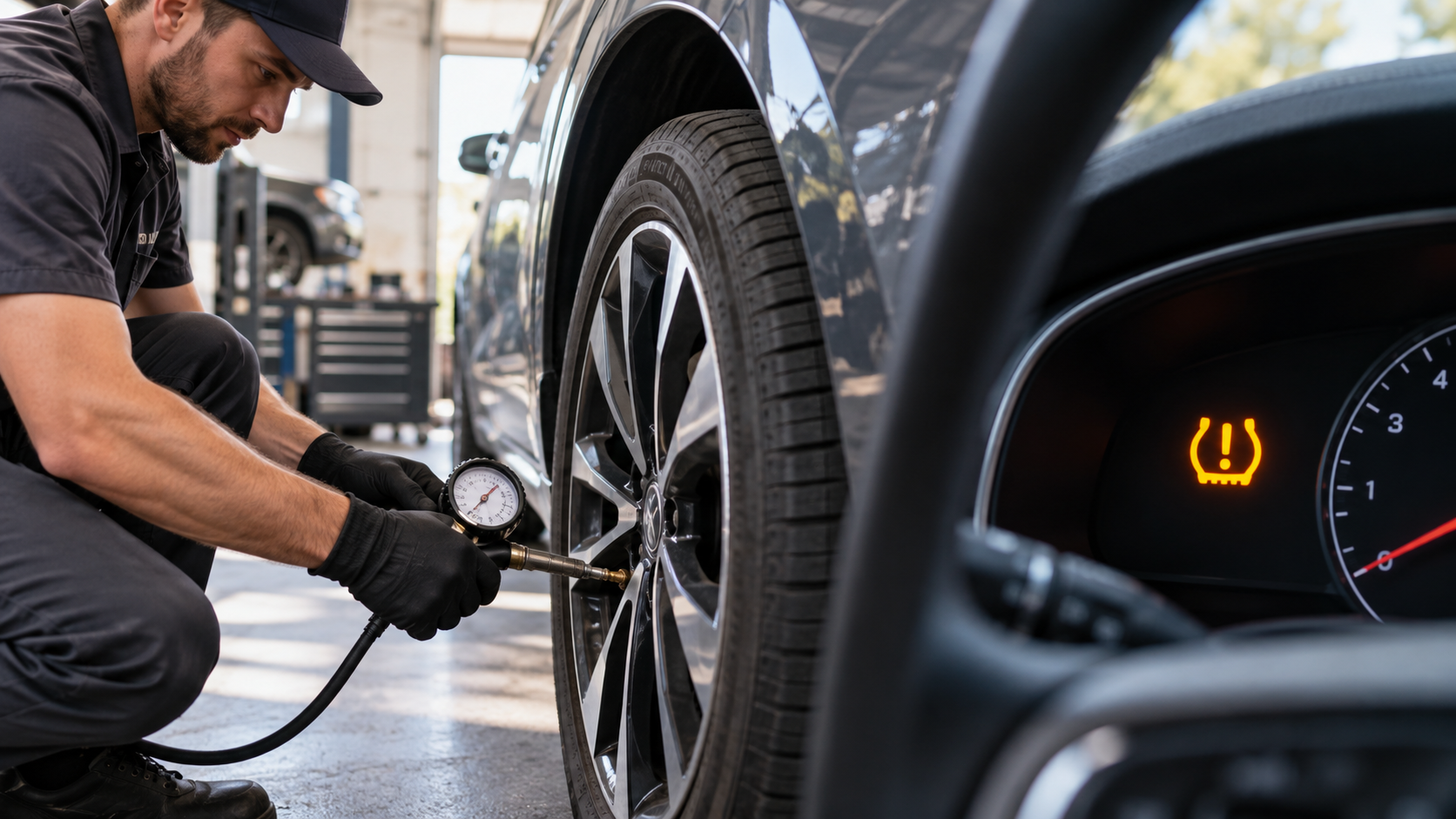
You start the car, glance at the dashboard, and instead of the familiar low-tire-pressure symbol, you see a message that says “Service Tire Monitor System.”
That wording can be confusing. Is a tire actually low? Is one of the wheels damaged? Did a sensor suddenly fail? And can you keep driving?
In many vehicles, a service tire monitor system message means the tire-pressure monitoring system, usually called TPMS, has detected a problem with the monitoring system itself. That is different from simply telling you that one or more tires need air.
The actual tires still matter, of course. You should check their pressure first. But if the pressures are correct and the service message remains, the car may not be receiving reliable information from one or more tire-pressure sensors.
Sometimes the fix is straightforward. A sensor battery may have reached the end of its life. A tire shop may have replaced or rotated wheels without completing the required relearn procedure. A sensor can also be damaged during tire service.
Other times the issue involves programming, communication, wiring, or a control module.
So the warning should not be ignored, but it also does not automatically mean you need four new tires.
What Does the Tire Monitor System Actually Do?
The tire-pressure monitoring system helps alert the driver when tire pressure becomes significantly low.
Most modern U.S. passenger vehicles have TPMS because federal requirements have applied to new light vehicles for many years. The system is meant to provide a warning when tire pressure falls enough to become a safety concern.
There are two broad types of systems: direct and indirect.
A direct TPMS uses pressure sensors associated with the wheels. These sensors measure tire pressure and send information wirelessly to the vehicle.
An indirect system does not measure tire pressure directly. Instead, it uses wheel-speed information and other vehicle data to identify changes that can suggest a tire has lost pressure.
Direct systems are very common in the U.S., and they are also the ones most closely associated with sensor battery failures and sensor replacement.
| TPMS Type | How It Works | Common Service Issues |
|---|---|---|
| Direct TPMS | Uses sensors at the wheels to measure tire pressure | Dead sensor battery, damaged sensor, missing sensor, relearn needed |
| Indirect TPMS | Uses wheel-speed and vehicle data to detect pressure-related changes | Calibration needed, wheel-speed sensor issues, incorrect tire setup |
Service Tire Monitor System Is Not the Same as Low Tire Pressure
This is the key difference.
A normal low-pressure warning means the monitoring system is functioning and has detected a tire that may be underinflated.
A service tire monitor message often means the vehicle is not completely confident in the monitoring system itself.
Think of it like a home smoke detector.
A low-tire-pressure warning is similar to the alarm detecting smoke. A service TPMS warning is closer to the detector saying, “My battery or electronics may not be working properly.”
That matters because once the monitoring system has a fault, it may not warn you correctly if a tire later loses pressure.
You can still check tire pressure manually with a gauge, and you should.
What Should You Do First?
Before assuming a sensor has failed, check the tires themselves.
Use an accurate tire-pressure gauge and check all four tires when they are cold. If the vehicle has a full-size spare equipped with TPMS, that tire may also need attention depending on the vehicle.
Compare the readings with the pressure listed on the vehicle’s tire-information placard, usually found on the driver’s door jamb or door frame.
Do not automatically use the maximum pressure molded into the tire sidewall. That is not the same thing as the vehicle manufacturer’s normal recommended cold inflation pressure.
Your first checks should be simple:
- Measure all tire pressures when the tires are cold.
- Compare them with the vehicle’s recommended pressure.
- Inspect each tire for obvious damage, punctures, or a visibly low appearance.
- Look for a TPMS warning light in addition to the dashboard message.
- Think about whether the warning started after tire replacement, rotation, wheel work, or seasonal wheel changes.
- Check whether the vehicle recently had a dead or disconnected 12-volt battery.
If one tire is genuinely low, correct the pressure and inspect for the reason it lost air.
If all tires are properly inflated and the service message remains, the TPMS system itself becomes more suspicious.
Why TPMS Sensors Eventually Fail
Direct TPMS sensors usually contain small sealed batteries.
Those batteries are not something you recharge every few months. They are designed to last for years, but they do not last forever.
Once the battery becomes too weak, the sensor may stop transmitting consistently or may stop communicating altogether.
A typical sensor can last many years, but exact life varies with design, temperature, driving patterns, transmission frequency, and vehicle use.
If your vehicle is around seven, eight, nine, or more years old and still has its original TPMS sensors, a sensor battery becomes a very reasonable possibility.
That does not mean all four sensors automatically need replacement at the same moment. But if several are the same age, it is possible for another one to fail not long after the first.
A Sensor Can Also Be Damaged During Tire Service
TPMS sensors live in a rough environment.
They deal with vibration, heat, moisture, road salt, tire mounting, tire removal, and years of driving.
Many direct sensors are attached to the valve stem or mounted inside the tire near it.
During tire replacement, a technician has to know where the sensor sits. Tire-changing equipment can damage a sensor if the wheel is handled incorrectly.
Valve stems and related service parts can also corrode or leak over time.
If a service tire monitor system message appears immediately after new tires were installed, that timing is worth mentioning to the tire shop.
What Is a TPMS Relearn?
Cars need to know which sensors belong to them.
On some vehicles, they also need to know which sensor is at the left front, right front, left rear, and right rear wheel.
A relearn procedure teaches the vehicle this information.
The exact process varies widely.
Some vehicles can relearn sensors automatically after a period of driving. Others require a specific sequence involving the ignition, steering-wheel controls, tire pressure changes, a special activation tool, or a diagnostic scanner.
And yes, this is where online advice gets messy. A relearn process that works on one model may be completely wrong for another.
If the warning started immediately after wheel rotation or sensor replacement, an incomplete relearn may be the whole problem.
Can Tire Rotation Trigger a TPMS Warning?
Sometimes.
The rotation itself does not damage a healthy sensor. But some vehicles track sensor position.
After the wheels are moved, the vehicle may need to relearn which sensor is located at each corner.
Without the correct relearn, the dashboard may show incorrect tire locations or may report a system fault depending on the vehicle.
Other cars are more relaxed about it and relearn automatically.
There is no universal procedure for every U.S. vehicle.
Why Seasonal Wheel Changes Can Cause the Message
This is especially common for drivers who keep a second set of wheels for winter tires.
Imagine your summer wheels have four programmed TPMS sensors. In November, you install a winter wheel set that either has no sensors or has sensors the car does not recognize.
The vehicle starts looking for its familiar sensor IDs and cannot find them.
Result: a tire-monitor warning.
If the winter wheels have compatible sensors, they may still require programming or relearning.
Some vehicles can store more than one set of sensor IDs. Others cannot.
Can Cold Weather Cause a Service Tire Monitor System Message?
Cold weather commonly causes low-pressure warnings because tire pressure drops as ambient temperature falls.
But temperature alone does not usually mean the monitoring system has failed.
If temperatures fall sharply overnight, you may see a low-tire-pressure warning simply because all four tires lost a few PSI relative to warmer weather.
Aging TPMS sensor batteries can also become less reliable in cold conditions, however. So an older sensor that barely worked in summer may start acting up during winter.
This is one reason a service message sometimes appears for the first time on a cold morning.
What Does a Flashing TPMS Light Mean?
On many vehicles, a TPMS indicator that flashes for a period after startup and then stays illuminated indicates a system malfunction rather than simple low tire pressure.
The exact warning behavior depends on the vehicle, so the owner’s manual remains the best reference for your dashboard.
If you see both a message and a flashing tire-pressure symbol, checking the actual pressures is still step one.
But if the pressures are correct, the system likely needs diagnosis.
Common Reasons the Warning Appears
The fault usually fits into a handful of categories.
- A TPMS sensor battery has become weak or dead.
- A sensor was damaged during tire or wheel service.
- A wheel was installed without a compatible TPMS sensor.
- A replacement sensor was never programmed correctly.
- The vehicle needs a TPMS relearn after tire rotation or sensor replacement.
- A valve stem or sensor component is damaged or corroded.
- The vehicle is receiving inconsistent sensor signals.
- An indirect TPMS system needs recalibration.
- A wheel-speed sensor or related system fault is affecting an indirect TPMS setup.
- A control module, antenna, wiring, or communication issue is present.
The sensor itself is a common cause, but it is not the only possible cause.
Can You Drive With the Warning On?
Usually, a TPMS system fault does not make the car instantly undrivable.
The issue is that you may no longer have reliable automatic tire-pressure monitoring.
That means you need to take over that job yourself until the system is repaired.
Check all tires manually before continuing normal driving. If the pressures are correct, the tires appear undamaged, and the car drives normally, you can usually arrange service without treating the situation like an immediate roadside emergency.
But do not use that as permission to ignore the message for six months.
A tire can lose air later, and a malfunctioning monitoring system may not warn you properly.
When You Should Stop Driving
The message itself may not demand an immediate stop, but the condition of the tires might.
Stop and inspect the vehicle if you feel a strong pull, hear repeated thumping, see a visibly flat tire, notice a sidewall bulge, or feel the handling suddenly change.
The same applies if the tire is losing pressure quickly after you inflate it.
A TPMS fault is an electronics problem. A damaged tire is a physical safety problem.
Those are different levels of urgency.
Can You Reset the Message Yourself?
Sometimes, but reset and repair are not the same thing.
If the system simply needs recalibration or a relearn after inflation or tire service, the owner’s manual may provide a procedure you can perform yourself.
But if a sensor battery is dead, resetting the dashboard will not magically recharge it.
Likewise, a damaged sensor will not heal because the warning was cleared.
This is an important distinction because people often search for a “TPMS reset” hoping to permanently remove the message.
If the underlying fault remains, the warning is likely to return.
How a Tire Shop Diagnoses TPMS Problems
Diagnosis is often faster than people expect.
A technician can use a TPMS activation or diagnostic tool near each wheel to see whether the sensor responds.
Depending on the equipment and vehicle, the tool may display sensor identification, pressure, temperature information, battery status indicators, or communication results.
If three sensors respond and one does not, that fourth sensor becomes an obvious suspect.
The shop can also scan the vehicle for diagnostic trouble codes related to the tire-monitoring system.
From there, the technician can determine whether the problem is a dead sensor, a programming issue, a relearn problem, or something further upstream.
What Happens When a TPMS Sensor Is Replaced?
A direct TPMS sensor replacement is usually performed while the tire is removed or partially demounted from the wheel.
The replacement sensor has to be compatible with the vehicle.
Then it may need programming and relearning so the car recognizes it.
Some replacement sensors are preprogrammed for specific applications. Others are programmable universal sensors that a shop configures for the vehicle.
After installation, the technician should verify that the vehicle receives information from the new sensor and that the warning is cleared.
Do All Four TPMS Sensors Need Replacement Together?
No, not automatically.
If one sensor has failed because it was physically damaged and the others are fairly new, replacing only the damaged sensor can make complete sense.
But if one original sensor battery dies on a vehicle whose other sensors are the same age, you may want to discuss the age of the remaining sensors with the shop.
Replacing one sensor today and another in three months can mean paying for repeated tire dismounting and service.
There is no universal answer. Age, condition, cost, and how long you plan to keep the vehicle all matter.
How Much Does TPMS Service Cost?
There is no single nationwide price because several very different repairs fall under “TPMS service.”
A simple relearn may be inexpensive or included with tire service.
Replacing one direct sensor costs more because you are paying for the sensor, tire-related labor, programming or relearning, and possibly valve-stem service parts.
Dealer pricing can differ from independent tire shops.
And if the fault involves a module, wiring, or another electronic component rather than the sensor itself, diagnostic time can become a larger part of the bill.
| Situation | Typical Type of Work | Relative Complexity |
|---|---|---|
| Low tire pressure only | Inflate tire and inspect for leaks | Low |
| Sensor position lost after rotation | TPMS relearn | Low to moderate |
| Dead sensor battery | Replace sensor and relearn | Moderate |
| Sensor damaged during tire work | Replace and program sensor | Moderate |
| Winter wheels not recognized | Program or relearn compatible sensors | Varies |
| Module or communication fault | Electronic diagnosis and repair | Potentially higher |
Can You Replace a TPMS Sensor at Home?
Technically, experienced DIYers can handle some TPMS jobs, but replacing an internal sensor normally requires tire-service equipment.
The tire has to be moved away from the sensor without damaging the tire or wheel.
Then the new sensor may need to be programmed and relearned.
For most drivers, this is a job that makes more sense at a tire shop.
Checking tire pressure, inspecting the valve stem, reading the owner’s manual, and initiating a simple manufacturer-provided relearn procedure are more reasonable DIY tasks.
What About Valve Stem Leaks?
A TPMS-equipped valve stem can leak just like a conventional valve stem.
Corrosion, damaged seals, valve-core problems, or physical damage can let air escape.
This creates a slightly confusing situation: the TPMS sensor may work perfectly and correctly report low pressure, while the leak is actually coming from the sensor’s valve assembly.
A technician can test the valve area for leakage.
Service kits are available for many sensor designs, and some components may be replaced without replacing the entire sensor if the sensor electronics remain healthy.
Why Correct Tire Pressure Still Matters When TPMS Works
TPMS is a warning system, not a maintenance plan.
You should not wait for the dashboard light before checking tire pressure.
A tire can be below its ideal recommended pressure without immediately triggering the warning threshold.
Proper pressure supports predictable handling, tire life, braking, fuel efficiency, and heat management.
Checking pressure once a month and before long trips is still a sensible habit.
Can Changing Tire Size Affect the System?
It can, especially with indirect systems.
An indirect TPMS depends on wheel-speed behavior. Changing tire diameter, mixing tire sizes, or fitting tires with substantially different rolling circumference can affect the data the system uses.
Direct TPMS systems care more about compatible sensors and proper programming, but tire and wheel changes still need to respect vehicle requirements.
If you install aftermarket wheels, confirm that they can accept compatible TPMS sensors and that the overall tire setup is appropriate for the car.
Why the Spare Tire Can Sometimes Be Involved
Not every vehicle monitors the spare, but some do.
If a full-size spare has a sensor, low pressure or sensor failure in that spare can sometimes trigger a warning even though the four tires on the road appear fine.
That catches people off guard because the spare may not have been touched for years.
If your owner’s manual says the spare is monitored, include it when investigating unexplained TPMS warnings.
What if the Message Appears and Disappears?
Intermittent faults can be annoying, but they are useful clues.
A weak sensor battery may transmit inconsistently. Temperature changes may affect an aging sensor. Communication can occasionally fail and then return.
If the warning repeatedly appears and disappears, write down when it happens.
Cold mornings? Highway driving? Immediately after starting? Only after switching between wheel sets?
Patterns help.
A shop can also scan for stored TPMS trouble codes even if the message is not visible at that exact moment.
Does Disconnecting the Car Battery Fix TPMS?
Usually not if a real hardware fault exists.
Disconnecting the 12-volt battery may clear or reset certain systems temporarily, but it does not replace a dead sensor battery, repair a damaged valve stem, or restore a failed sensor.
It may also reset other vehicle memories and settings.
So pulling the battery cable is not a great universal “fix the dashboard light” strategy.
Diagnose the cause instead.
Can a Scan Tool Tell You Which Sensor Is Bad?
Often, yes.
A capable TPMS tool or diagnostic scanner can help identify which wheel sensor is not responding or which fault code the vehicle has stored.
This is why professional diagnosis can save money compared with replacing sensors randomly.
If one sensor is silent and the other three respond normally, there is little reason to guess.
Test first.
What If the Warning Started After New Tires?
Call the tire shop and explain exactly when the message appeared.
A sensor may need relearning. A sensor could have been damaged. A wheel may have been installed with a sensor the car does not recognize. Or the vehicle may simply need to be driven through its normal learning cycle.
Do not automatically assume the new tires themselves are defective.
The timing simply makes the recent wheel and sensor work the logical place to start.
Three Things That Matter Most
If you remember nothing else, remember these basics:
- A low-pressure warning and a TPMS system fault are not exactly the same thing.
- Always verify actual tire pressure manually before diagnosing the electronics.
- If the system is malfunctioning, do not rely on it to warn you about future pressure loss until it is repaired.
That covers most of the practical safety issue.
FAQ
What does Service Tire Monitor System mean?
It usually means the vehicle has detected a problem with its tire-pressure monitoring system rather than simply detecting low pressure. A sensor, sensor battery, programming, relearn process, or another TPMS component may be involved.
Can I drive with a Service Tire Monitor System message?
If all tires have been manually checked, pressures are correct, the tires are undamaged, and the vehicle drives normally, you can usually drive while arranging service. Until the system is repaired, do not rely on TPMS to warn you about future pressure loss.
Can low tire pressure cause the service message?
Low tire pressure normally triggers the low-pressure warning, while a service message often points to a system fault. Because dashboard behavior differs between vehicles, always check the actual pressures first.
How do I know which TPMS sensor is bad?
A tire shop or technician can activate each sensor with a TPMS tool and see whether it responds. Diagnostic codes may also identify the affected sensor position or communication problem.
Will a TPMS warning go away after adding air?
A normal low-pressure warning may clear after the tires are correctly inflated and the vehicle is driven. A service-system warning caused by a dead or damaged sensor usually will not be permanently fixed by adding air.
How long do TPMS sensor batteries last?
They commonly last for several years, often well beyond the original tire set, but exact life varies. As a vehicle gets older, dead internal sensor batteries become a more common cause of TPMS faults.
Do new TPMS sensors need programming?
Many replacement sensors need programming, relearning, or both. The exact process depends on the vehicle and the type of replacement sensor being installed.
Conclusion
A service tire monitor system warning sounds more dramatic than it often is.
In many cases, the tires themselves are fine and the problem is one small electronic sensor that has stopped communicating.
But that does not mean the warning is pointless.
The TPMS is there to tell you when tire pressure becomes dangerously low. If the monitoring system cannot reliably communicate with its sensors, you lose part of that early-warning system.
Start with the tires, not the electronics.
Check all four pressures with a gauge while the tires are cold. Compare them with the pressure listed on the vehicle’s placard. Inspect the tires for leaks, damage, bulges, or anything else that looks unusual.
If the pressures are correct and the warning stays on, think about what happened recently.
Were the tires rotated?
Did you install new tires?
Did you change from summer wheels to winter wheels?
Was a sensor replaced?
Did the warning appear for the first time on an older vehicle during cold weather?
Those details can point directly toward a relearn problem or aging sensor battery.
On direct TPMS systems, the wheel sensors are small battery-powered radio devices living inside an environment that is not exactly gentle. Eventually, some fail.
That is normal aging, not necessarily evidence of a major vehicle problem.
If the warning appeared immediately after tire service, have the shop check sensor communication and programming. If the vehicle is older and one original sensor has gone silent, battery age becomes more likely.
A proper TPMS tool can usually tell the technician a lot more than guessing from the dashboard.
And that is worth doing.
Replacing random sensors can waste money, especially when the real issue is a relearn procedure or an incompatible wheel sensor.
Also remember that tire pressure monitoring does not replace manual tire checks.
Even with a perfectly functioning TPMS, you should still check pressure periodically. The dashboard system is designed as a warning mechanism, not as your everyday pressure gauge.
If the monitoring system is faulty, those manual checks become even more important.
A service message by itself does not usually mean you need to stop the car immediately.
But a flat tire, sidewall bulge, strong pull, rapid pressure loss, or sudden handling change is a different situation entirely.
Always judge the actual tire condition first.
And if the tires look fine but the warning refuses to disappear, let a tire shop or technician check the sensors.
Quite often, the solution is much less dramatic than the dashboard message makes it sound.
Leave a Reply