
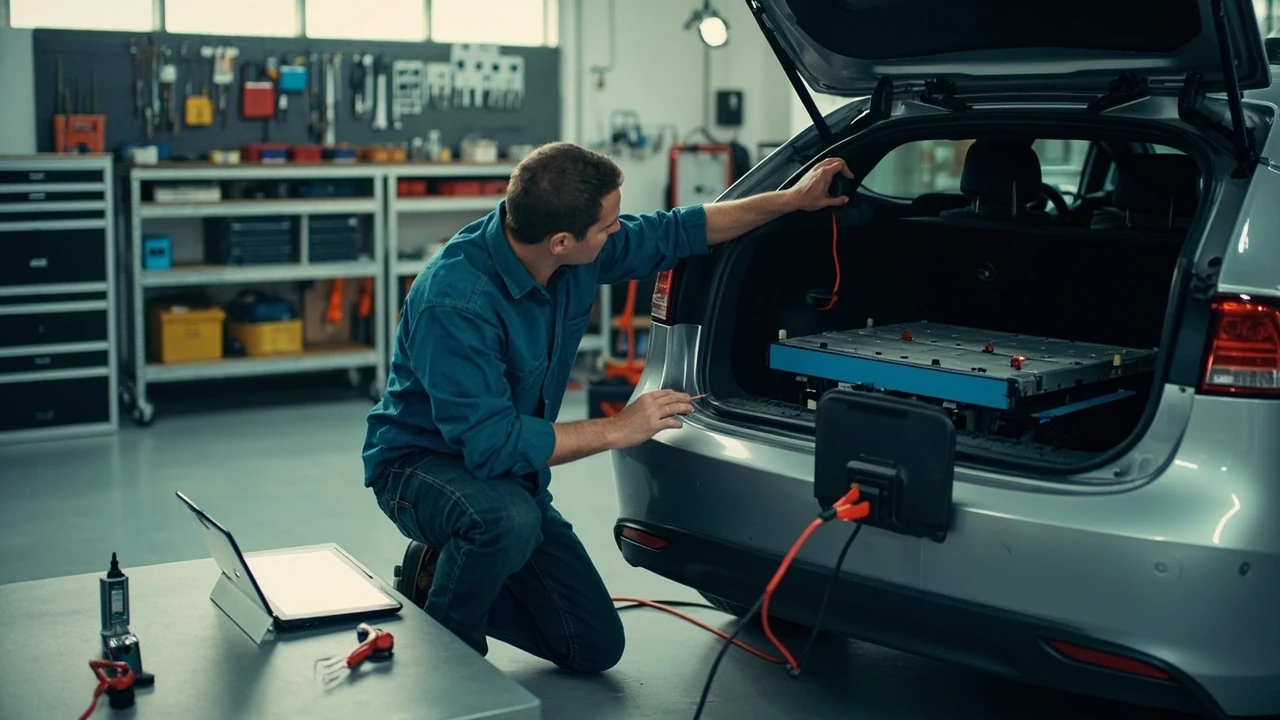
Electric vehicle repair: what owners should know
A warning light, reduced driving range, or a charging connector that will not latch can send an electric vehicle owner looking for repair help without knowing whether the problem is in the battery, an electronic control module, a charging connection, or something much simpler. The right first step is to identify the symptom, determine whether the vehicle is safe to drive or charge, and avoid opening or testing high-voltage components without the correct training and equipment.
Electric vehicle repair is not simply conventional automotive repair with a different engine in the same location. A battery-electric vehicle uses a high-voltage battery, traction motor, power electronics, sensors, thermal controls, and software that coordinate their operation. Plug-in hybrids add a combustion engine and fuel system to those components. Knowing which type of vehicle you own helps a technician select the correct diagnostic procedure and repair information.
Most owners can safely handle documentation, charging-port inspection, software updates provided by the manufacturer, tire service, brake inspection, and basic fluid checks. High-voltage battery enclosures, orange cables, charge ports, and certain underbody components require additional precautions. The sections below focus on a single practical goal: recognizing the difference between a routine owner check, a diagnosable fault, and work that belongs in a properly equipped repair facility.
How electric vehicle repair differs from gas vehicle repair
Many familiar maintenance needs remain. Tires still wear, brakes still consume friction material, suspension components still wear out, and vehicles still require fluid, belt, wiper, and filter service where applicable. An electric vehicle may need brake service less often in some driving patterns because regenerative braking reduces brake use, but that does not make the brake system maintenance-free. If the vehicle cannot regenerate under specific conditions, a technician may need to check the brake friction system rather than assume that the brake pads are worn out.
The major difference is the high-voltage system. A high-voltage battery can deliver substantial current, and the vehicle may retain stored energy even when it is switched off. Repair procedures therefore begin with more than a key or ignition-off command. Depending on the manufacturer and model, the technician may need to follow a specified disconnect procedure, wait period, testing method, and reconnect sequence.
| System | What the owner may notice | Why professional diagnosis may be needed |
|---|---|---|
| High-voltage battery | Reduced range, charge interruption, unusual cooling behavior, or a battery-related warning | Cell conditions, internal disconnects, thermal systems, and module diagnostics may require specialized tools |
| Charge port and charger | Connector will not latch, charging stops, or the vehicle will not begin a charge | The fault may involve the vehicle inlet, cable, charger, communication, or power controller |
| Traction motor and inverter | Reduced power, warning message, unusual noise, or limited-speed operation | Electrical insulation, coolant conditions, phase measurements, and control signals must be checked safely |
| DC/DC converter and low-voltage system | 12-volt warning, failed accessories, or inability to start the vehicle | The converter may depend on the high-voltage system, and diagnostics may require a scan tool |
| Brakes, steering, and suspension | Vibration, pulling, grinding, or abnormal tire wear | These systems remain mechanically similar to other vehicles, but their control inputs and wear patterns can differ |
Vehicle architecture also affects how faults appear. A dashboard message may be the visible result of several failed sensors rather than a damaged engine component. Software can change what a warning means, and a diagnostic technician needs the vehicle identification number, model year, trim, and manufacturer service information to interpret it correctly. Generic handheld scanners may read a generic code but omit the detailed data, freeze-frame information, or guided tests required for a complete diagnosis.
Do not assume that a lack of engine oil means the vehicle needs no fluid service. Many EVs still require brake fluid, transmission fluid for reduction gears on some models, coolant for thermal systems, and sometimes washer fluid or other consumables. Service intervals vary by model, so the owner’s manual and manufacturer schedule should take priority over a generic EV checklist.
Read the warning and symptoms before scheduling service
A useful repair visit begins with a symptom that someone else can reproduce. Note when the issue occurs, whether the vehicle is cold or warm, how recently it happened, and what changed immediately before it appeared. If the car is moving unsafely, has damaged wiring, is hot to the touch in an unusual area, smells burned, or is leaking fluid, stop driving it and arrange transport or roadside assistance rather than continuing to test.
Warning messages should be photographed exactly as they appear. Do not dismiss a message because the vehicle still drives. A reduced-power message can indicate that the control system has limited the vehicle to protect the battery or another component. Likewise, a tire-pressure warning in an EV deserves attention because heavy battery packs can affect how the vehicle handles a tire with low pressure or damage. The guide to service tire monitor warnings explains how drivers should read the different stages of a tire monitoring alert.
Before contacting a shop, make a concise service record with the following details:
- The vehicle’s year, make, model, trim, and approximate mileage
- The exact warning text or symbol, photographed if possible
- When the problem began and whether it is intermittent or constant
- Recent charging attempts, software updates, collisions, towing, or unusual weather exposure
- Whether the vehicle can move under its own power, and at what speed
- Any visible damage, fluid leakage, unusual odor, or repeated fuse issue
Do not ignore a recurring message simply because turning the vehicle off clears it. Intermittent faults can overwrite useful data when the vehicle is restarted. A technician may need the original failure information, and the driver may need to describe the conditions that trigger the problem so the diagnostic test can be repeated safely.
Also distinguish a charging problem at one location from a vehicle-side fault. Try a different known-functional charging station or outlet only when that is safe and permitted by the charging network. If the same vehicle fails at multiple locations, the issue may be in the vehicle. If it fails only at one connector, that connector, cable, payment system, or stall may be involved. A fault at home may point to the outlet, charging cord, or electrical supply rather than the car.
Diagnose battery, range, and charging complaints
Range complaints deserve careful measurement because driving conditions can make a large difference. Highway speed, cold temperatures, repeated hard acceleration, a full passenger compartment, roof-mounted equipment, and repeated regenerative braking can all affect the displayed range. One long trip is not enough to establish whether the battery has lost capacity. Compare the vehicle’s recent energy use and charging behavior with its own history when possible, while recognizing that ambient conditions can change.
Many battery-related messages are triggered by conditions outside the cells themselves. The pack may be too cold or hot for charging, a cooling circuit may not be circulating coolant as expected, a cell or module voltage may be outside its permitted range, or a battery contactor may not have closed. A “service” message does not automatically mean the entire battery pack has failed. It identifies a condition that the vehicle’s control system considers abnormal.
| Observed problem | Possible checks before repair | Repair approach |
|---|---|---|
| Range has declined noticeably | Compare recent efficiency, driving conditions, tire pressure, and dashboard estimates | Measure usable energy and capacity, inspect for abnormal cell behavior, and verify cooling and control-system operation |
| Charging stops or restarts | Check connector seating, charging limits, available power, and repeatability at another site | Inspect the inlet and cable, review fault history, and test charge communication and power-control components |
| Battery temperature warning appears | Confirm whether the car has been recently fast-charged, cold-soaked, or driven hard | Inspect coolant flow, pumps, valves, fans, temperature sensors, and thermal-control logic |
| Vehicle cannot start because the low-voltage battery is weak | Check age, terminal condition, and whether the vehicle completed enough charging or driving to recharge | Test the 12-volt battery and charging system, then check the DC/DC converter and high-voltage interlocks |
The low-voltage battery deserves special attention. Electric vehicles commonly use a conventional 12-volt battery to operate control modules, contactors, lights, and accessory circuits. A weak or failed low-voltage battery may prevent the high-voltage system from starting normally. Drivers who need help understanding electrical readings can use the site’s explanation of car battery voltage as background, but a technician should still test the EV’s charging and power-conversion system rather than replacing parts by assumption.
A repair should not begin with replacing the traction battery merely because the vehicle shows a battery message. Proper diagnosis may involve reading manufacturer-specific fault data, checking cell or module balance, measuring insulation and high-voltage interlock signals, inspecting cooling equipment, and verifying recent software versions. These tests should be performed with the correct procedures because incorrect probing can damage electronics or expose the technician to stored energy.
For battery work, ask what the shop intends to do after isolating the fault. A responsible estimate should identify the diagnostic step, the component or condition being evaluated, and what happens if the test does not confirm the suspected cause. It should also address battery cooling, firmware, water intrusion, impact damage, or cell imbalance if the vehicle history suggests those possibilities.
Inspect the charge port, charger, and electrical connection
A charging complaint may involve hardware that looks simple but operates with coordinated locks, sensors, and high-current contacts. If the connector does not latch, do not force it. Check whether debris, ice, a bent pin, a worn cable, or another visible obstruction is present. A connector that becomes warm or smells unusual should not be used again until it has been inspected. Heat at the plug, inlet, or cable can indicate a high-resistance connection.
The broad overview of vehicle electrification explains why battery-electric, hybrid, and plug-in hybrid vehicles are related but not mechanically identical. That distinction matters because a procedure suitable for one powertrain may be unsafe or ineffective on another.
Try to determine where the failure disappears. If the vehicle will not recognize any charger, inspect the inlet, charge-port lid or door mechanism, onboard charger, and communication circuits. If it works with one charger but not another, test a known-good compatible cable or charging unit. If charging begins and stops only at a particular state of charge, investigate battery temperature, pack voltage behavior, cooling, and charging control.
Home charging also introduces variables beyond the vehicle. Verify that the outlet is in good condition, fully seated, and appropriate for the charger’s requirements. Check for heat discoloration, loose plates, damaged cord sections, or a plug that does not remain firmly connected. An electrician may be needed to evaluate the supply, grounding, or circuit load. The EV technician can determine whether the vehicle-side charge port works correctly once the electrical supply has been ruled out.
Do not use an extension cord unless the charger manufacturer specifically permits it and the instructions are followed. Do not use a damaged or wet charging connector. Do not continue a charge when the connector is not fully inserted, even if the vehicle appears to accept it. The locking mechanism and pilot signals are part of the safety system, not obstacles to work around.
A useful test sequence is:
- Confirm the charger is compatible with the vehicle and rated for the intended connection.
- Inspect the plug, cable, inlet, and outlet for visible damage or contamination.
- Verify that the connector fully seats and that the charging interface displays a normal ready state.
- Test at another suitable charging location to separate a vehicle fault from a site-specific issue.
- Record the vehicle’s fault message and charging behavior before disconnecting or changing components.
Understand traction motor, inverter, and reduced-power faults
A traction motor fault can appear as reduced power, a maximum-speed limitation, a readiness-system message, or an inability to complete certain drive modes. Some electric motors are oil-cooled or indirectly cooled, while others rely on different thermal arrangements. Inverters convert direct current from the battery into alternating current used by many traction motors, and they also work with the control modules to manage torque and power.
Unusual sounds require context. A brief whir during acceleration is normal for many electric powertrains because there is no engine at idle. A grinding sound, metallic impact, scraping noise, or continuous vibration is not explained away by the powertrain type. Stop driving if a sound is accompanied by a warning, loss of power, or vibration. If the vehicle remains stationary, a technician can evaluate tires, brakes, wheel bearings, motor mounts, and other mechanical sources before concluding that the motor is damaged.
Vibration can also come from a wheel or suspension component rather than the motor. The site’s explanation of causes behind car shaking can help owners describe the vibration accurately, including its speed, direction, and whether it occurs during braking or acceleration.
Inverter and motor faults may be related to coolant leaks, damaged connectors, failed sensors, insulation faults, or control-module errors. A reliable diagnosis should connect the electrical symptom to a measurable condition. Simply replacing an inverter because a generic code appears may discard a functional expensive component and leave the underlying issue in place.
Road testing may be appropriate after a repair, but it should follow the service center’s safety procedure. A technician may need to confirm that the insulation monitoring system, high-voltage interlock, thermal controls, and fault indicators operate as expected before returning the vehicle to a customer. The owner should ask how the repaired condition was verified, including whether the vehicle completed a full charge-discharge cycle or a controlled road test when required.
Decide what you can safely do yourself
Owner-level service is appropriate when the task is clearly outside the high-voltage system and the manufacturer’s instructions support it. For an EV, that may include checking tire pressure, inspecting tires and wheels, replenishing approved washer fluid, maintaining exterior and cabin filters where applicable, checking accessible fluid levels, and using the vehicle’s built-in diagnostic pages. Even simple tasks should follow the owner’s manual for the specific model.
| Task | Owner-level activity | Workshop activity |
|---|---|---|
| Tire and wheel service | Visual inspection, pressure check, and tire rotation when allowed | Balancing, puncture repair, replacement, sensor replacement, or wheel service |
| Brake system | Listen for changes and visually inspect accessible components | Pad and rotor measurement, brake fluid service, caliper repair, and electronic parking brake diagnosis |
| Charging cable and inlet | External visual check and careful connector handling | Connector pin testing, inlet repair, communication checks, and high-voltage measurement |
| 12-volt battery | Terminal and surface inspection with the vehicle powered down | Load, capacity, charging-system, and parasitic-drain testing |
| High-voltage battery | Read the displayed condition and report changes | Isolation, cell and module testing, cooling inspection, firmware checks, and repair or replacement |
Begin with low-risk checks before ordering parts. Confirm the display and owner’s manual support the procedure, use the correct connector and protective equipment, and work in a dry, well-ventilated area. Do not open a charging cable to expose terminals, probe the high-voltage connector, remove an orange cable, puncture a battery module, or work beneath a vehicle supported only by a jack. These actions can cause serious injury or damage.
After market adapters, extension cords, and unapproved chargers create unnecessary risk. Use equipment rated and approved for the vehicle’s charging system. If a cable becomes unusually hot, discolored, wet, or physically damaged, unplug it if safe and stop using it until it has been evaluated.
Choose a technician with EV-specific capability
When selecting a shop, look for a technician who understands the exact powertrain rather than someone who simply owns a general repair shop. Ask whether the facility has the manufacturer’s service information, diagnostic tools, high-voltage PPE, insulated instruments, charging equipment, and a safe way to isolate the vehicle. A dealership may have direct access to model-specific software and parts, while an independent EV specialist may offer broader experience across brands. Neither label alone proves that the repair will be done correctly.
Use the following questions when requesting an estimate:
- Do you routinely service this powertrain and this make or model?
- Will the diagnostic fee apply to the repair if you approve the work?
- What tests will you perform to confirm the cause before replacing parts?
- Can you explain which findings support the proposed repair?
- Does the estimate include labor, parts, taxes, diagnostic fees, software updates, and any required cooling or electrical checks?
- How will the battery, inverter, charge port, or other repaired system be tested before delivery?
- What parts warranty or labor coverage applies, and are manufacturer software campaigns covered?
Be cautious with a diagnosis that consists only of a warning code. A useful estimate names the complaint, explains the diagnostic path, and distinguishes the cost to diagnose from the cost to repair. If the technician cannot explain why a component needs replacement, ask for the evidence behind the recommendation.
Ask how the shop will protect the vehicle during service. For example, the high-voltage system may need to be isolated before work near certain components, and a damaged or wet battery may require special handling. Reputable facilities should also document the initial condition, disclose additional findings, and obtain approval before exceeding the authorized estimate.
Before accepting the vehicle, review the paperwork and verify that warning messages have been cleared. Confirm that the repair invoice identifies the work performed, the parts used, the battery state of health if applicable, and any limitations that should be monitored. If the problem was intermittent, ask what condition was needed to reproduce it and how likely a recurrence is if the exact cause remains uncertain.
Frequently asked questions
Can I repair an electric vehicle battery myself?
No. High-voltage battery packs can retain dangerous energy and contain complex electrical, thermal, and mechanical systems. An owner should not open the pack, disconnect high-voltage cables, probe terminals, or attempt module-level work. Safe owner actions are limited to reading the vehicle’s condition information, maintaining the charge port externally, and reporting a warning promptly.
Why is my electric vehicle showing reduced range?
Reduced range can result from weather, driving speed, passenger and cargo load, accessory use, tire condition, or a change in driving habits. It can also indicate a battery, cooling, or control-system fault. Compare recent efficiency with the vehicle’s own history under similar conditions. If the change is sudden, repeated, or accompanied by a warning, request a diagnostic inspection rather than assuming normal variation.
Why does my EV refuse to charge?
The cause may be a connector that is not fully seated, a charging limit, an incompatible or damaged cable, a site power issue, an inlet fault, or a vehicle-side communication or battery condition. Record the error, check the connector and outlet, and try another suitable charging location. If the vehicle fails in multiple places, schedule vehicle diagnostics.
Can I replace the 12-volt battery in an electric vehicle?
Some models allow an owner to replace the low-voltage battery, but the process can involve wake-up states, terminal access, programming, and vehicle-specific precautions. Consult the owner’s manual before doing so. If the battery repeatedly runs down while the vehicle is properly charged, test the DC/DC converter and low-voltage charging system because replacing the battery alone may not solve the cause.
Do electric vehicles still need brake and suspension service?
Yes. Regenerative braking can reduce friction-brake use, but brake fluid, calipers, pads, rotors, tires, wheel bearings, and suspension components still wear or require inspection. A repair shop should check why wear or a symptom is occurring rather than assuming that an EV needs less brake service than another vehicle.
Does an EV service visit require a battery discharge?
Not always. The required procedure depends on the complaint and the technician’s findings. Some diagnostics can be performed with the vehicle connected to a suitable charger, while controlled charging or discharge tests may be used for battery, range, or thermal issues. The service plan should state whether energy will be added or removed and how the vehicle will be returned to the customer’s expected charge level.
What information should I give the repair shop?
Provide the vehicle identification number, year, make, model, mileage, exact warning message, and a clear description of when the fault occurs. Note recent charging attempts, software updates, collisions, towing, unusual sounds, and whether the issue can be reproduced. Clear information can shorten the diagnostic process and help prevent an unnecessary parts replacement.
Is it safe to drive an EV with a battery warning?
It depends on the message and the vehicle’s condition. A generic battery warning may lead to reduced power, while signs of damaged wiring, unusual heat, odor, leaking fluid, or a visibly compromised pack require stopping and professional assistance. If the vehicle drives normally and the manufacturer does not instruct otherwise, schedule prompt service and describe the exact message. Do not ignore the warning for an extended period.
How can I reduce the risk of future EV repair?
Keep the tires in good condition, use compatible charging equipment, avoid repeated deep discharges when the manufacturer recommends retaining reserve charge, and follow the prescribed service schedule. Address tire, brake, suspension, and cooling symptoms early, keep charging ports clean and dry, and install manufacturer software updates when provided. Consistent maintenance records also help technicians identify changes more quickly.
Leave a Reply